
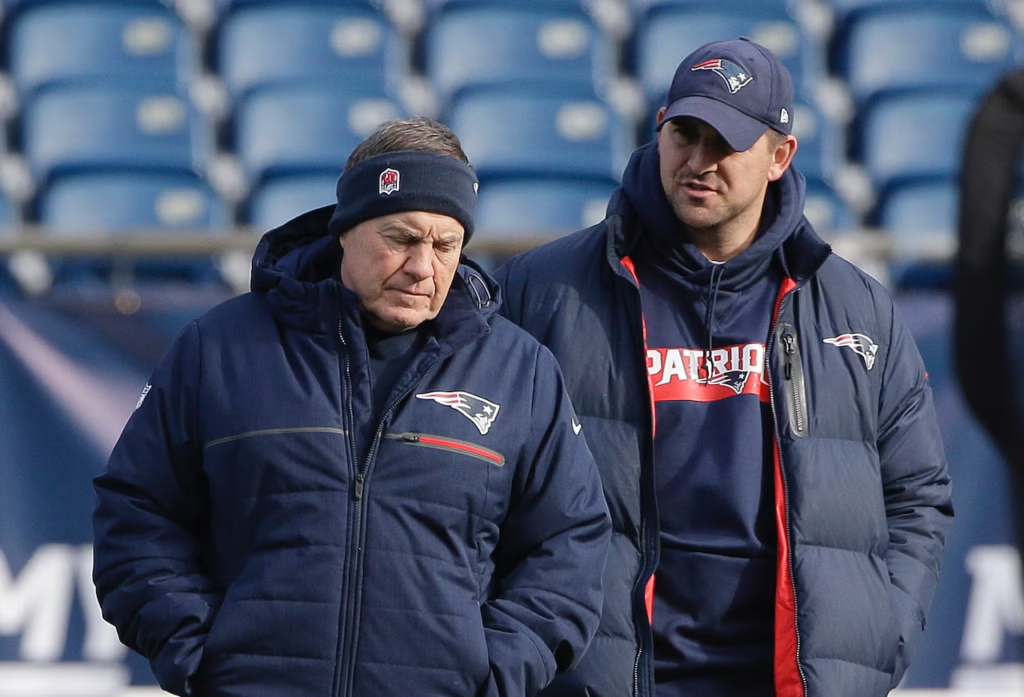

Joe Judge is one of the most intriguing coaching figures in modern American football. Known for his no-nonsense personality, detail-oriented approach, and strong background in special teams, Judge has built a career shaped by discipline, structure, and mentorship under legendary coaches like Nick Saban and Bill Belichick. His journey from a college player at Mississippi State to winning Super Bowls with the New England Patriots, and eventually becoming the head coach of the New York Giants, reflects both his potential and the challenges of leading an NFL franchise.
This article explores Joe Judge’s full football career—his early life, entire coaching path, philosophies, highs, lows, controversies, dismissal from the Giants, return to coaching, and long-term impact on the sport.
Early Life and Education
Birth and Upbringing
Joseph F. Judge was born on December 31, 1981 in Philadelphia, Pennsylvania. He grew up in Doylestown, a suburb known for its strong school systems and competitive athletics. From childhood, Judge was exposed to football through a family environment that valued toughness and competitiveness. His father, Joseph, played football at Temple University; the sport was deeply embedded in the family identity.
High School Career
Judge attended Lansdale Catholic High School, where he played quarterback and punter. Although not a national recruit, he earned local recognition for his intelligence, leadership, and dedication—traits that would later define his coaching.
Coaches from his high school noted even then that Judge had “a coach’s mindset,” often spending extra hours studying film, helping teammates understand schemes, or running drills.
College Football at Mississippi State
Joe Judge enrolled at Mississippi State University, playing from 2000 to 2004. He was listed as a quarterback but spent most of his playing time contributing to special teams—serving as a holder, punt protector, and situational player.
More importantly, Judge excelled academically:
He earned a spot on the SEC Academic Honor Roll
Was listed multiple times on the Dean’s List
Graduated with a degree in psychology
Later completed a master’s degree while coaching
His intellectual approach to the game, combined with modest playing experience, shaped him into a future teacher of the sport.
Coaching Career: Early Stages
Joe Judge entered coaching immediately after college, building his career step-by-step through assistant roles.
Mississippi State (2005–2007)
Graduate Assistant
Judge’s coaching career began at his alma mater. Working as a graduate assistant, he helped with special teams, defensive drills, film breakdown, and player development. He absorbed every detail he could, learning the craft from the ground up.
This was also where he discovered his passion for teaching players fundamentals and technique.
Birmingham–Southern (2008)
Linebackers Coach & Special Teams Coordinator
In 2008, Judge accepted a dual-role opportunity at Birmingham–Southern, a small Division III program. He coached linebackers and coordinated special teams—his first real leadership experience.
Here he learned the importance of:
Player fundamentals
Scheme installation
Game-plan preparation
Practice structure
Communication skills
Even at a small school, his special teams units were organized and highly disciplined.
Rise Under Nick Saban at Alabama (2009–2011)
Joe Judge’s career accelerated when he joined Nick Saban’s Alabama staff as a football analyst and special teams assistant. Working under Saban is considered one of the biggest development opportunities in football.
During Judge’s time at Alabama:
Alabama won the 2009 National Championship
Alabama won another national title in 2011
Judge helped prepare some of the best special teams units in the nation
Saban’s influence on Judge included:
Attention to detail
Structured team culture
Strict discipline
Step-by-step process-based development (“The Process”)
Fierce competition in practice
This period shaped Judge’s future coaching identity more than any other experience.
New England Patriots Era (2012–2019)
Judge’s NFL breakthrough came when Bill Belichick hired him in 2012. This decision would define his career and build his reputation.
2012–2014: Special Teams Assistant
Judge joined as an assistant to special teams coordinator Scott O’Brien. Working daily with Belichick—one of the greatest special teams minds in football—Judge gained invaluable experience.
Belichick trusted him early, and Judge quickly became known as:
A strong communicator
A film-driven strategist
Hard-working and tough
Smart with situational football
2015–2019: Special Teams Coordinator
In 2015, Judge was promoted to Special Teams Coordinator. This placed him among the youngest coordinators in the NFL.
Under Judge, the Patriots’ special teams became one of the league’s most reliable units.
Key strengths:
Excellent punt coverage
Smart kickoff strategies
Limiting opponents’ return yards
Well-prepared situational plays
Aggressive and disciplined coverage units
Super Bowl Success
During Judge’s tenure, the Patriots won:
Super Bowl XLIX (2014)
Super Bowl LI (2016)
Super Bowl LIII (2018)
His special teams unit delivered clutch plays in all these seasons.
Unique Role in 2019: Wide Receivers Coach
In 2019, Judge took on a rare dual role:
Special Teams Coordinator
and
Wide Receivers Coach
He became the only coach in the NFL that season to oversee both a full position group and special teams. This expanded responsibility showcased Belichick’s trust and Judge’s versatility.
Head Coach of the New York Giants (2020–2021)
On January 8, 2020, Joe Judge was named the 19th head coach of the New York Giants. For many fans, this was a surprising move: never before had Judge been a coordinator on offense or defense, yet he was entering one of the most historic NFL franchises as its leader.
Judge’s Leadership Philosophy
Judge brought with him:
Saban’s discipline
Belichick’s structure
A detail-oriented, fundamentals-first identity
High expectations for players
A “no excuses, no nonsense” culture
He demanded:
Hard practices
Accountability
Toughness
Situational mastery
Some players respected this approach; others struggled with it.
2020 Season: A Year of Growth
Judge’s rookie season as head coach got off to a slow start (0-5). Injuries, including Saquon Barkley’s ACL tear, made things worse. However, the team gradually improved.
Highlights:
Defense became one of the top units in the league
Giants finished 6–10, second in NFC East
The team fought hard for him, showing discipline and effort
Judge earned media praise for his attitude and football intelligence
The season ended with optimism despite the losing record.
2021 Season: Controversy and Collapse
The second season was dramatically different. The Giants slid to 4–13, one of the worst records in the league.
Problems included:
- Offensive Struggles
The offense was statistically among the NFL’s least productive.
- Injuries
Key players missed large chunks of the season.
- Game Management Criticism
Judge made questionable decisions, including:
Challenging a non-reviewable scoring play
A notorious QB Sneak on 3rd-and-9 near their own goal line
These decisions became viral moments and attracted widespread criticism.
- Emotional Press Conference Rant
After a late-season loss, Judge delivered an 11-minute monologue defending his program. Many saw it as defensive and desperate.
Firing
On January 11, 2022, the Giants fired Joe Judge. His overall record:
10 wins
23 losses
.303 winning percentage
The front office described the decision as necessary for a “new direction.”
Return to New England Patriots
Despite the difficult ending in New York, Bill Belichick quickly brought Judge back into the Patriots organization.
2022: Offensive Assistant & QBs Coach
Judge worked with quarterbacks, though the offense struggled. His role shifted again after 2022.
Transition to College Football: Ole Miss (2024–Present)
In 2024, Joe Judge joined Ole Miss as a senior analyst—returning to college football roots.
In 2025, he was promoted to Quarterbacks Coach, working under Lane Kiffin. This marked a fresh chapter, giving him:
A reset from NFL pressure
Opportunity to coach younger players
A chance to rebuild his reputation
Many analysts believe Judge may work his way back into a major coaching role, possibly even as a future defensive or special teams coordinator in the NFL.
Coaching Style and Philosophy
Joe Judge’s approach is heavily influenced by Nick Saban and Bill Belichick.
Core Beliefs
Process Over Results
Judge emphasizes consistency and day-to-day improvement.
Discipline
Players must follow strict rules, show respect, and give maximum effort.
Fundamentals
Blocking, tackling, technique, and film study come before creative game plans.
Mental Toughness
Judge demands commitment and resilience.
Strengths
Strong communicator with assistants
Excellent special teams strategist
Good teacher for young players
Highly organized and structured
Criticisms
Methods may feel too rigid for some players
Demanding personality sometimes clashes with modern NFL culture
Conservative in game-day decisions
Media communication occasionally backfires
Legacy and Long-Term Impact
Even though Judge’s time as a head coach was short, he left a significant mark on football.
Impact on Special Teams Coaching
Judge’s path demonstrated that special teams coaches can become head coaches—rare in NFL history.
Belichick Coaching Tree
Judge remains part of one of football’s most influential coaching networks.
Shaping Young Players
Whether in the NFL or college, Judge is praised for mentoring young athletes.
Lessons From the Giants Tenure
His failure as a head coach has become a case study in:
The challenges of culture-building
Balancing discipline with adaptability
Managing relationships with modern players
Will Joe Judge Become an NFL Head Coach Again?
Many analysts believe:
Judge still has strong leadership skills
He may not get another NFL head-coaching job soon
But he could rise again as a top coordinator
His return to college football could revive his career
Given his age—early 40s—he has decades left to grow.
Conclusion
Joe Judge’s story is one of perseverance, discipline, and high expectations. His coaching journey—from Alabama to three Super Bowl championships, then leading the New York Giants, and later returning to coaching roles—illustrates both success and struggle.
He has earned respect as:
A passionate teacher
A brilliant special teams mind
A tough, process-driven leader
Though his head-coaching tenure had challenges, his future remains full of possibilities. Whether in college football or a return to the NFL, Joe Judge continues to be a compelling and influential figure in the football world.