
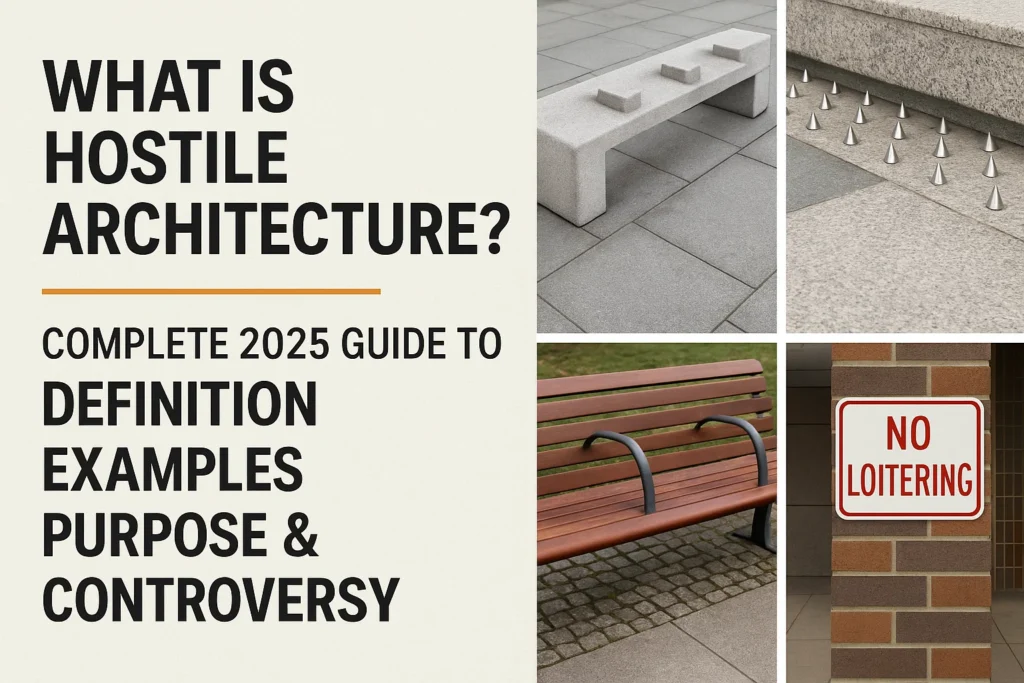

Hostile architecture—also known as defensive architecture, unpleasant design, anti-homeless design, or defensive urbanism—has become one of the most controversial elements of modern city planning. In the past decade, public spaces around the world have quietly transformed as cities adopt design tactics that discourage certain behaviors, especially resting, sleeping, loitering, skateboarding, or gathering in groups.
Supporters of hostile architecture argue that it keeps public spaces safe, controlled, and functional. Critics claim it is a form of architectural discrimination—a physical strategy used to push homeless people, teenagers, skateboarders, and other “undesirable” groups out of sight. As urban life becomes more crowded and complex, the debate around hostile architecture has intensified.
This 3,000-word article offers a complete 2025 guide to hostile architecture: its meaning, history, techniques, examples, ethical debates, social consequences, alternatives, and the future of public design.
- What Is Hostile Architecture?
Hostile architecture refers to deliberate design choices in public spaces meant to discourage certain behaviors or exclude specific groups of people. These design strategies are subtle, often hidden in plain sight, and crafted to influence human behavior without passing explicit laws.
Common targets include:
Homeless individuals (preventing sleeping or resting)
Teenagers (discouraging loitering or group gathering)
Skateboarders
People who sit for long periods
Public drinkers or overnight visitors
The main purpose is behavior control through design, not policing. It is architecture with intent.
1.1 Why Is It Called “Hostile”?
The design is considered hostile because:
It doesn’t solve social problems.
It makes public space less welcoming.
It physically excludes vulnerable communities.
It uses architecture as a tool of social control.
Yet not all examples are extreme; some are subtle.
- The Origins of Hostile Architecture
While it feels modern, defensive design has existed for centuries.
2.1 Historical Precursors
Examples include:
Medieval spikes on walls to prevent climbing.
Stone cobbles in alleyways to prevent sleeping.
Fences and gates designed to limit access.
Barriers to keep animals or people out of cities.
Throughout history, power structures have used physical design to control behavior.
2.2 Rise in the 1980s–2000s
Modern hostile architecture emerged as cities grew more crowded and homelessness increased. Influenced by:
Neoliberal urban policies
Privatization of public spaces
Crime Prevention Through Environmental Design (CPTED)
“Broken windows theory” of policing
By the early 2000s, hostile design became normalized across the UK, US, Europe, and Asia.
2.3 The 2010s to 2025 Expansion
The rise of social media exposed hostile design practices:
Photos of anti-homeless spikes went viral worldwide.
Communities began publicly criticizing cities.
Urban designers became divided on ethics.
Despite criticism, hostile architecture continues to spread globally.
- Common Examples of Hostile Architecture
Hostile design takes many forms, some obvious, others extremely discreet.
3.1 Anti-Homeless Architecture
The most controversial category.
3.1.1 Anti-Homeless Spikes
Metal or concrete spikes installed on flat surfaces
Prevent lying or sitting
Seen in doorways, outside shops, building steps
3.1.2 Segmented or Slanted Benches
Benches are divided by metal bars or made slanted so:
People cannot lie down
Resting becomes uncomfortable
Examples include:
“Camden benches” in London
Curved benches in Los Angeles
Narrow, short, tilted benches in train stations
3.1.3 Fenced or Gated Underpasses
Under bridges and flyovers, fences are installed to:
Prevent encampments
Control foot traffic
3.1.4 Rocks & Boulders in Public Spaces
Large rocks placed where people used to sleep or set up tents.
3.2 Anti-Loitering Architecture
Designed to prevent hanging around or gathering.
3.2.1 Anti-Teenager Devices
Such as:
Ultrasonic “Mosquito devices” producing high-frequency sound only young people can hear
Blue lighting to highlight acne and discourage teenagers from gathering
3.2.2 Divided Seating
Benches with individual seats discourage long conversations or group gatherings.
3.3 Anti-Skateboarding Architecture
Examples:
Metal studs on ledges
Curved edges on benches
Rails or bumps to prevent grinding
Skateboarding contributes to wear-and-tear, so cities install deterrents.
3.4 Anti-Rough-Sleeping Landscaping
Some landscapes intentionally make sleeping impossible:
Spiked or rocky gardens under bridges
Sloped ground
Bushes planted under staircases
Uneven surfaces
3.5 Anti-Lingering Sound & Light Design
Non-physical tools include:
Classical music played loudly
Pink noise
Bright lights used to keep people awake
These methods push people away without visible architecture.
- Why Do Cities Use Hostile Architecture?
Cities often justify hostile design for several reasons:
4.1 Maintenance & Cleanliness
Public spaces experience:
Littering
Vandalism
Wear from activities like skateboarding
Design deters damaging activities.
4.2 Crime Prevention
Planners argue defensive design:
Reduces drug use
Controls gangs
Prevents overnight camping
Keeps public spaces “orderly”
4.3 Business Interests
Commercial areas want:
High foot traffic
Welcoming environment for customers
No loitering near storefronts
Businesses lobby cities for defensive designs.
4.4 Crowd Control
Architectural design can:
Direct flows of movement
Prevent congestion
Limit unwanted behaviors
4.5 Aesthetic Preferences
Some designers view defensive design as:
“Clean”
“Minimalist”
“Efficient”
Even if socially questionable.
- Ethical Debates & Social Criticisms
Hostile architecture is one of the most debated urban design topics in 2025.
5.1 It Targets Vulnerable Groups
Critics argue it:
Punishes homeless people instead of helping them
Forces them into more dangerous places
Treats poverty as a crime
Excludes youth and marginalized communities
Public space becomes a space for some, not for all.
5.2 Criminalization Without Due Process
Instead of using legal restrictions, architecture silently:
Removes rights
Controls behavior
Evades accountability
No law is broken, yet people are excluded.
5.3 Public Spaces Becoming “Private by Design”
Even when publicly funded, these spaces are designed like private property.
5.4 Psychological Harm
Hostile design communicates:
“You are unwanted.”
“You don’t belong here.”
“Your presence is a problem.”
This creates social anxiety and isolation.
5.5 Homelessness Is a Social Issue, Not an Architectural One
Critics argue:
The solution to homelessness is housing—not spikes, fences, or benches you can’t sleep on.
- Hostile Architecture and Homelessness
This is the most sensitive and controversial area.
6.1 Homelessness Is Increasing Globally
Urban homelessness has risen due to:
Housing shortage
High rents
Economic instability
Mental health challenges
Migration
Cities respond with physical exclusion rather than social care.
6.2 Defensive Architecture Makes Life Harder
It pushes homeless individuals to:
Unsafe areas
Remote alleyways
Isolated industrial zones
Hostile architecture does not remove homelessness; it hides it.
6.3 Public Backlash
Viral photos of anti-homeless spikes have ignited global outrage. Communities demand:
Removal of hostile designs
Replacement with humane options
Greater focus on shelter programs
- Economic Aspects: The Cost of Hostile Design
Surprisingly, hostile design is often expensive.
7.1 Installation Costs
Anti-homeless spikes, specialized benches, and metal studs require:
Custom manufacturing
Professional installation
Maintenance
Cities spend thousands instead of investing in long-term social solutions.
7.2 Hidden Costs
Hostile design increases:
Policing costs
Cleanup costs in new displacement areas
Healthcare costs for the homeless
7.3 Beneficiaries
Commercial districts
Private security firms
Urban developers
- Psychological Impact on Society
Hostile architecture affects everyone—not just targeted groups.
8.1 Reduced Sense of Community
Public spaces feel:
Unwelcoming
Controlled
Cold
People interact less.
8.2 Increased Social Segregation
Physical exclusion reinforces:
Class divides
Wealth-based separation
“Us vs. them” mentality
8.3 Mental Health Consequences
When public space becomes hostile, anxiety increases:
People feel watched or controlled
Reduced freedom of movement
Constant discomfort
Civic life deteriorates.
- Cultural and Political Dimensions
Hostile architecture is also a cultural reflection.
9.1 Architecture as Political Expression
Design can express:
Fear of poverty
Desire for order and cleanliness
Social control
Economic priorities
It reveals a city’s values.
9.2 Public VS Private Ownership Debate
Questions arise:
Who is public space for?
Should everyone have equal access?
Do businesses control public behavior?
9.3 Media Attention
Social media activism is exposing hostile design:
Hashtags like #HostileArchitecture
Viral photos
Community movements
- Alternatives to Hostile Architecture
Cities worldwide are testing humane and creative solutions.
10.1 Inclusive Design
Designing spaces for everyone, such as:
Long benches without dividers
Sheltered seating
Public rest areas
Wide-open park areas
10.2 Housing-First Solutions
Proven to reduce homelessness:
Affordable housing
Shelters with services
Integrated community programs
10.3 Social Architecture
Examples:
Public community kitchens
Daytime resting centers
Help desks in transit stations
Accessible public toilets
10.4 Youth-Friendly Spaces
Creating:
Teen zones
Skate parks
Sports courts
This reduces conflict with teenagers.
10.5 Public Art Installations
Replace hostile design with:
Murals
Sculptures
Interactive art
Comfortable seating
- Successful Case Studies of Inclusive Urbanism
11.1 Helsinki, Finland
Free public seating everywhere
No anti-homeless design
Social workers integrated into city spaces
11.2 Portland, Oregon
Replaced anti-homeless benches with:
Public rest pods
Warming shelters
Resource centers
11.3 Barcelona, Spain
Invested in:
Affordable housing
Community gardens
Youth engagement programs
Demonstrating that cities can be inclusive and functional.
- The Future of Hostile Architecture (2025–2030)
Urban design trends show two possible futures:
12.1 A More Controlled City
If hostile architecture continues to grow:
Public spaces may become sterilized
People may feel constantly monitored
Architecture may enforce strict behavioral norms
12.2 A More Humane City
If cities shift to inclusive design:
Public spaces become community hubs
Homelessness is addressed with support
Youth and marginalized groups feel welcome
12.3 Technological Trends
New tools are emerging:
Smart benches
AI crowd-monitoring systems
Sensor-based deterrents
These raise privacy concerns.
- Conclusion: The Ethical Crossroads of Urban Design
Hostile architecture is more than metal spikes or divided benches—it is a mirror of how societies treat vulnerability, poverty, youth, and public life. Cities built for exclusion become shallow, tense, and controlled. Cities built for inclusion become vibrant, safe, and alive.
The debate is not about benches or spikes—it is about what kind of society we want to live in.
Do we want public spaces that welcome everyone?
Or public spaces that quietly push unwanted people away?