
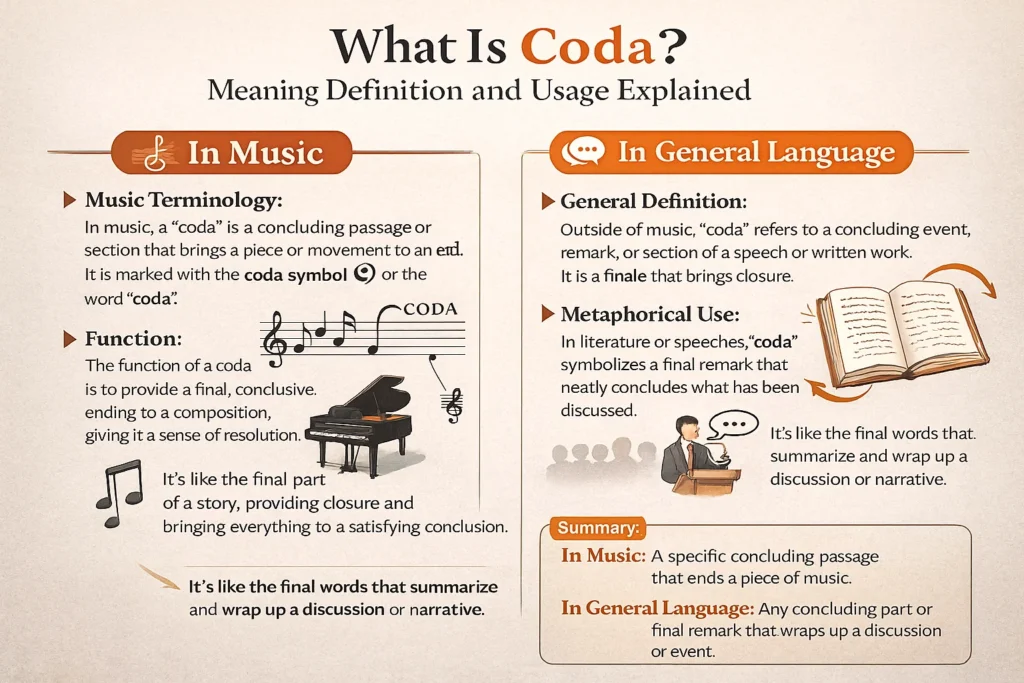

The word coda carries with it an air of finality, refinement, and structural perfection. Derived from the Italian word for “tail,” it is a term that has gracefully slithered out of its primary domain in musical notation to find profound relevance in literature, linguistics, business, and everyday life. A coda is not merely an ending; it is a considered, crafted conclusion that provides resolution, commentary, or a final, transformative twist. To understand coda is to understand the philosophy of closure itself.
Part I: The Musical Coda – Foundation and Function
In its original and most precise context, a coda (pronounced KOH-duh) is a distinct, concluding section of a musical composition or movement. It is not part of the main thematic or developmental material but serves as a final punctuation mark, bringing the piece to a satisfying and definitive close.
Historical Evolution:
The concept of a coda evolved with musical form. In the Baroque and early Classical periods, endings were often simple cadences repeated for emphasis. However, as compositions grew in complexity and scale—particularly in the sonata-allegro form favored by Haydn, Mozart, and Beethoven—the need for a more substantial conclusion became apparent. The development section explored harmonic tension and thematic fragmentation; the coda became the necessary space to re-establish tonal stability and provide a sense of completeness that a simple recapitulation could not.
The Master of the Coda: Ludwig van Beethoven
Beethoven transformed the coda from a conventional tail into a second development section, a dramatic and often powerful finale. In his works, the coda could:
Reinforce the Triumph: As in the iconic final movements of his Fifth Symphony, where the coda hammers home the victory of major over minor.
Provide Philosophical Resolution: As in the final movement of his Ninth Symphony (“Choral”), where after the colossal “Ode to Joy,” the coda accelerates into a transcendent, almost frenzied celebration.
Introduce New, Conclusive Material: Sometimes, a truly masterful coda introduces a final, unforgettable theme that exists only to crown the work, leaving the listener with a last, lingering impression.
Structural Position and Identification:
In a typical sonata-allegro form (Introduction / Exposition / Development / Recapitulation / Coda), the coda begins after the final cadence of the recapitulation. It is often heralded by specific musical cues: a sustained chord, a pause, or a clear harmonic shift. For the listener, it’s the moment you sense the piece is “wrapping up,” but doing so with intentional artistry rather than simply stopping.
Types of Musical Codas:
Standard Coda: A brief, concluding few bars that solidify the home key.
Grand Coda (or Coda Grande): An extended, often complex section that can feel like a miniature movement in itself, common in opera finales and large Romantic symphonies.
Codetta: A “little tail,” usually found at the end of a section within a piece (like the exposition) to close that section before moving on.
In sheet music, the coda is famously marked by a specific symbol: ⊕. When this symbol appears in the music, along with a matching “To Coda” direction, it instructs the performer to jump from one part of the piece to this distinct concluding section, often after repeating earlier passages.
Part II: The Literary and Narrative Coda – Echoes After the Climax
Literature and film enthusiastically borrowed the term to describe a concluding part of a narrative that stands outside the main plot’s structure. A narrative coda serves functions analogous to its musical counterpart, but with the tools of language and story.
Functions of a Literary Coda:
Temporal Shift and Aftermath: It fast-forwards in time to show the long-term consequences of the story’s events, the “ever after” in the “happily ever after.” George Eliot’s Middlemarch ends with a famous coda updating the reader on the futures of its sprawling cast.
Thematic Resonance and Reflection: It steps back to offer a final philosophical meditation on the story’s meaning. The haunting, reflective coda of F. Scott Fitzgerald’s The Great Gatsby (“So we beat on, boats against the current…”) is a prime example.
Providing Closure or Deliberate Open-Endedness: It can tie up loose ends for minor characters or, conversely, introduce a final, ambiguous image that reframes the entire narrative. The final chapter of Margaret Atwood’s The Handmaid’s Tale, presented as a historical lecture, is a coda that radically recontextualizes the novel’s personal horror.
Direct Address or Metafictional Commentary: The author or narrator may directly address the reader, breaking the fourth wall to deliver a final thought. This is a classic device used by authors like Charles Dickens and Italo Calvino.
Cinematic Codas:
In film, the coda is often the sequence after the central climax and conflict have been resolved. Think of the endings of the Lord of the Rings films, where after the destruction of the Ring, extended codas in Minas Tirith and the Shire allow for emotional farewells and a gentle return to peace. Christopher Nolan’s Inception uses its controversial, spinning-top final shot as a kind of visual-philosophical coda that invites endless debate, functioning precisely like a musical coda that introduces one last, haunting idea.
Part III: The Linguistic Coda – The Tail End of a Syllable
In the science of phonetics and phonology, coda has a highly technical and structural meaning. It refers to the final part of a syllable, following the vowel nucleus. The basic structure of a syllable is (Onset) + (Nucleus) + (Coda).
Onset: The initial consonant(s) (e.g., ‘s’ in “sat”).
Nucleus: The vowel or syllabic core (e.g., ‘a’ in “sat”).
Coda: The final consonant(s) (e.g., ‘t’ in “sat”).
Examples:
The word “cat” /kæt/: Onset = /k/, Nucleus = /æ/, Coda = /t/.
The word “strengths” /strɛŋkθs/: A complex example where the coda is the entire cluster /ŋkθs/.
An “open” syllable has no coda (e.g., “go” /ɡoʊ/).
A “closed” syllable ends with a coda (e.g., “gone” /ɡɒn/).
The study of permissible codas is key to understanding the accent and rhythm of a language. Japanese, for instance, has very restrictive codas (often only the nasal ‘n’), while English and German permit complex consonant clusters (“twelfths” /twɛlfθs/).
Part IV: The Conceptual Coda – Metaphor for Modern Endings
The power of “coda” as a metaphor has led to its widespread adoption in diverse fields, always retaining its core idea of a formal, reflective conclusion.
In Business and Technology: A project’s “coda” might be the post-mortem analysis, the lessons-learned document, or the final presentation that encapsulates the journey and outcomes. It’s the structured reflection after the product launch.
In Journalism and Essays: A coda can be a final, standalone paragraph that zooms out from the specifics of the article to offer a broader perspective, a prediction, or a poignant anecdote that encapsulates the piece’s essence.
In Personal Life and Psychology: We speak of the “coda” of a relationship, a career, or a life chapter—a period of intentional closure, processing, and meaning-making before moving on. It is the conscious act of concluding, rather than just letting things fade.
In Popular Culture: The title of the Oscar-winning film CODA (Child of Deaf Adults) is a brilliant pun. It refers literally to the hearing child who is the “coda” to her Deaf family, and metaphorically to her role as the one who will eventually leave to start her own life’s melody, providing a new conclusion to the family’s story.
Part V: Coda vs. Epilogue, Denouement, and Finale
Understanding coda requires distinguishing it from its close cousins:
Denouement: This is the “untying of the knot” in a plot. It occurs immediately after the climax, resolving the central conflict and explaining lingering questions. The coda often comes after the denouement.
Epilogue: This is the closest synonym in narrative. However, an epilogue is almost always a distinct chapter or section explicitly labeled as such. A coda can be more integrated, subtler, and can exist within the final chapter as its concluding passage.
Finale: This is a broader term for the last part of anything, especially a performance. It emphasizes spectacular conclusion rather than reflective closure. A finale is about the last act; a coda is about the last thought.
The Philosophy of the Coda: Why Endings Matter
The cultural journey of “coda” reveals a deeper human truth: we are creatures who crave meaningful endings. An abrupt stop is unsettling; a mere fade-out feels evasive. The coda satisfies a profound aesthetic and psychological need for resolution. It allows for:
Integration: It helps the audience or reader integrate the experience, transforming a sequence of events into a coherent whole.
Emotional Processing: It provides the time and space for the emotional impact of a journey to settle.
Legacy and Meaning: It frames what came before, shaping how we will remember it. A great coda can elevate a good work into a timeless one.
Conclusion: The Final, Resonant Note
From the thunderous final chords of a Beethoven symphony to the quiet last sentence of a novel, from the intricate consonant cluster at the end of a word to the reflective period after a major life event, the coda is a testament to the power of a well-made ending. It is the architectural keystone that locks a structure into place, the period that completes not just a sentence, but a thought. It reminds us that form provides meaning, and that how we choose to conclude something—a piece of art, a project, a story—is ultimately a statement about its value. In a world often characterized by interruption and open loops, the coda stands as a beautiful, deliberate act of completion. It is the artist’s, the writer’s, and the individual’s final gift to their audience: the assurance that the journey was worth making, and that its conclusion, like a perfect cadence, feels both inevitable and right.