

The “coda,” derived from the Italian for “tail,” is a multifaceted conceptual tool that transcends individual disciplines to represent a universal principle of structured conclusion. This article provides a comprehensive, interdisciplinary analysis of the coda, examining its technical specifications, historical evolution, and philosophical implications in its three primary domains: Western art music, linguistic phonology, and literary/narrative structure. Moving beyond simple definition, we argue that the coda is not merely an ending but a transformational space where meaning is consolidated, tension is resolved, and the work achieves its final, definitive form. Through comparative analysis, we reveal the coda as a fundamental mechanism for achieving closure in human systems of communication and expression.
Part I: The Musical Coda – Architecture and Rhetoric in Sound
1.1 Formal Definition and Structural Identity
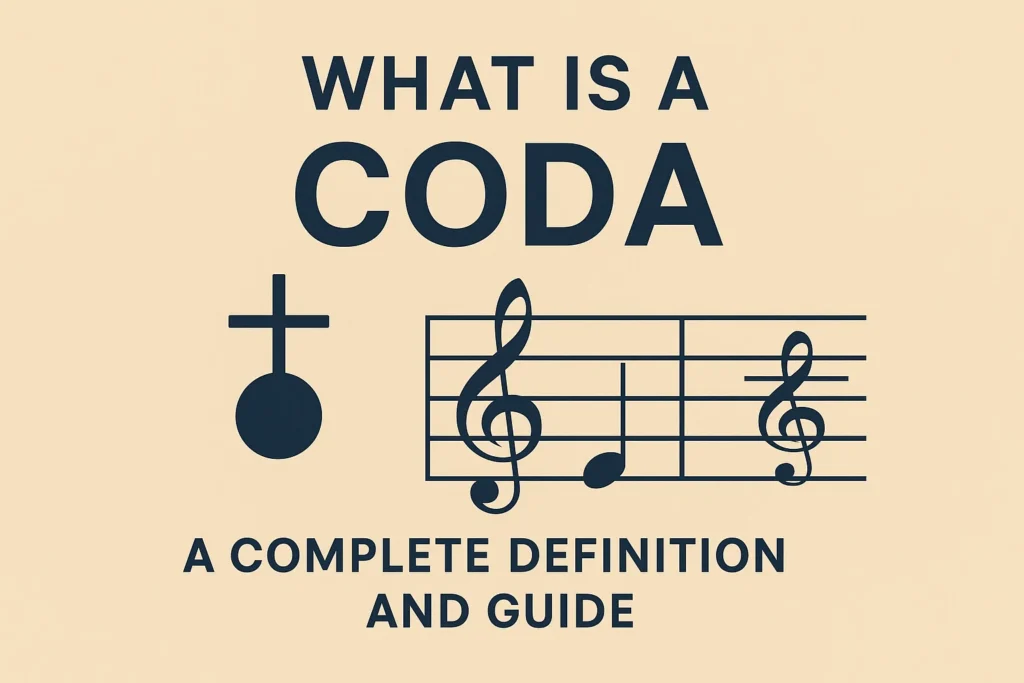
In musical theory, a coda is a distinct, concluding section that follows the main structural body of a movement or piece. It is not a random appendage but an integral part of the composition’s architecture, typically introduced after the final cadence of the recapitulation in sonata-allegro form. Its primary functions are threefold: to reinforce the tonic key, to provide a definitive sense of closure, and to offer a final, often summative, commentary on the work’s thematic material. The coda is formally indicated by the symbol 𝄌.
1.2 Historical Evolution: From Cadential Extension to Second Development
The coda’s role has evolved dramatically, reflecting broader shifts in musical aesthetics.
Classical Era (Pre- and Early Beethoven): Here, the coda was often a brief, cadential extension—a series of reinforcing perfect authentic cadences in the tonic key to politely but firmly signal the end. It was a formal necessity, a structural “tail” of modest proportions.
Beethovenian Revolution: Ludwig van Beethoven transformed the coda from a formal gesture into a dramatic and psychological necessity. In works like his Symphony No. 3 “Eroica” and Symphony No. 5, the coda expands into a vast, developmental space. It becomes a “second development section,” where thematic conflict reaches its ultimate resolution, often through relentless repetition, fugal treatment, or triumphant apotheosis. Beethoven’s codas don’t just end the piece; they resolve its existential struggles.
Romantic and Post-Romantic Eras: Composers like Brahms, Bruckner, and Mahler inherited Beethoven’s expansive model. The coda became a realm for transcendent summation, nostalgic recollection, or overwhelming climax. In Tchaikovsky’s symphonies, for instance, codas often deliver the fateful, catastrophic conclusion toward which the entire work has been hurtling.
1.3 Typology and Function: A Catalogue of Endings
Musical codas can be categorized by their primary rhetorical function:
The Summarizing Coda: Reiterates primary themes in a stabilized, triumphant tonic. (Example: The finale of Mozart’s Symphony No. 41 “Jupiter”).
The Developmental Coda: Introduces new counterpoint or fragmentation of themes, achieving resolution through exhaustive working-out. (Example: The first movement of Beethoven’s Symphony No. 5).
The Dissipative Coda: Instead of a climax, the music slowly fades, fragments, or evaporates into silence, suggesting ambiguity, loss, or infinite distance. (Example: The end of Sibelius’s Symphony No. 5, or the “Farewell” symphony by Haydn).
The Cyclical Coda: Recalls material from a movement’s introduction or from earlier movements, creating a sense of cyclic unity and closed narrative. (Example: The finale of Franck’s Symphony in D minor).
1.4 The Coda in Popular and Contemporary Music
The principle extends beyond classical forms. In popular music, the “outro” is the direct analogue. It can be a fade-out (a dissipative coda), a repeated vamp that diminishes, or a final, abrupt chord. In progressive rock and film scoring, codas often mirror the classical developmental model, providing an epic, thematic conclusion to a suite or soundtrack.
Part II: The Linguistic Coda – The Structural Finale of the Syllable
2.1 Phonological Definition and Syllabic Architecture
In phonology, the coda is the consonant or consonant cluster that follows the nucleus (the vowel or syllabic core) of a syllable. It is a constituent in the universal syllabic template: (Onset) + Nucleus + (Coda). The parentheses indicate optional elements; a syllable must have a nucleus but can lack an onset (e.g., “I” /aɪ/) or a coda (e.g., “see” /siː/). Syllables with a coda are termed closed syllables (“cat” /kæt/), while those without are open syllables (“go” /ɡoʊ/).
2.2 Phonotactics and Cross-Linguistic Variation
The permissible content of a coda is governed by a language’s phonotactic constraints—the rules defining possible sound combinations. This creates immense cross-linguistic diversity:
Restrictive Languages: Languages like Japanese and Hawaiian have highly restrictive codas. Standard Japanese essentially allows only the moraic nasal /N/ (as in “Nippon”) and the first part of a geminate consonant as a coda. This creates a preponderance of open (CV) syllables.
Permissive Languages: English and German allow complex codas with multiple consonants, subject to a sonority hierarchy (generally, less sonorous sounds like stops /t, p, k/ come closer to the nucleus than more sonorous ones like liquids /l, r/). A word like “strengths” /strɛŋkθs/ has a coda cluster /ŋkθs/ of four consonants, which is impossible in many languages.
Syllable-Weight Distinction: The presence of a coda often determines syllable weight, a critical feature for poetic meter and stress assignment. A “heavy” syllable (typically one with a coda or a long vowel) can bear stress differently than a “light” syllable (open with a short vowel).
2.3 The Coda in Morphology and Language Change
The coda plays an active role in word formation and historical sound change.
Morphological Boundaries: Inflectional suffixes often alter the coda (e.g., “walk” /wɔːk/ + /t/ → “walked” /wɔːkt/; the /t/ becomes the new coda).
Historical Phonology: Sound changes like final-obstruent devoicing in German (“Tag” /taːk/ vs. “Tage” /taːɡə/) specifically target coda position. The loss of final syllables in the evolution from Latin to Romance languages (e.g., Latin “panem” > French “pain” /pɛ̃/) is essentially the erosion of the coda and final nucleus over time.
Part III: The Narrative Coda – The Final Act of Meaning-Making
3.1 Definition as Epilogue and Perspective Shift
In literature, film, and drama, a coda is a final section that follows the narrative’s climax and denouement. It is more than an epilogue; while an epilogue may simply provide factual information about characters’ futures, a coda performs a thematic and perspectival shift. It steps outside the main plot’s timeline or point of view to offer a final reflection, establish an enduring emotional tone, or reframe the entire story.
3.2 Core Functions and Narrative Impact
Thematic Consolidation: It answers the “so what?” of the narrative. After the plot is resolved, the coda reveals the story’s ultimate philosophical or emotional meaning. In George Orwell’s Animal Farm, the final scene of the pigs and men indistinguishable through the farmhouse window is a devastating coda that cements the allegory about the corrupting nature of power.
Closure and Continuity: It bridges the story’s world with the ongoing flow of life or history. The “Nineteen Years Later” coda at the end of J.K. Rowling’s Harry Potter and the Deathly Hallows provides emotional closure by showing the characters healed and raising their own children, while also passing the torch, suggesting the cyclical nature of good and evil.
Irony and Recontextualization: A coda can undercut or ironically comment on the apparent resolution. The famous final shot of François Truffaut’s film The 400 Blows—a freeze-frame on the boy’s ambiguous gaze—is a coda that replaces closure with open-ended questions about his future.
Metafictional Commentary: In postmodern works, the coda may break the fourth wall, directly addressing the reader about the act of storytelling itself, as in John Fowles’s The French Lieutenant’s Woman.
3.3 The Coda Across Media
Film: Beyond final scenes, credit sequences often function as codas, using music, montage, or post-credit scenes to settle the audience’s mood or hint at sequel potential (e.g., the poignant photo montage in Schindler’s List, or the shawarma scene in The Avengers).
Television Series: Series finales often devote their final minutes to a powerful coda. The final scene of The Sopranos, with its abrupt cut to black, is a controversial but masterful coda that forces the audience to confront the perpetual anxiety and imminent violence of Tony Soprano’s life.
Video Games: Narrative-driven games use codas in end credits sequences that show the consequences of the player’s choices on the game world and characters, providing personalized closure (e.g., the slideshow in Fallout games).
Part IV: Synthesis – The Unified Theory of the Coda
Having examined the coda in isolation across three fields, we can now synthesize its universal principles.
4.1 The Core Commonalities: More Than Just an End
Structural Distinctness: In all cases, the coda is formally marked as separate from the main body. In music by the 𝄌 symbol, in language by its position after the nucleus, in narrative by a shift in time, perspective, or tone.
Function of Closure: Its primary role is to terminate, but termination is an active process. It moves the system (a piece of music, a syllable, a story) from a state of tension or openness to a state of rest or resolved meaning.
Transformational Space: The coda is rarely mere repetition. It is a space for final transformation—thematic working-out in music, completion of syllabic structure in language, and the crystallization of theme in narrative.
4.2 The Philosophical Underpinnings: Why Humans Need Codas
The ubiquity of the coda speaks to a deep cognitive and aesthetic human need.
Cognitive Preference for Closure: Gestalt psychology identifies the law of closure—our minds prefer complete, bounded forms over open, incomplete ones. The coda satisfies this preference by providing a perceptual and conceptual boundary.
The Desire for Meaning: We seek narratives, not just sequences of events. A coda helps convert a sequence (of notes, phonemes, plot points) into a coherent, meaningful whole with a defined ending point that colors all that came before.
Ritual and Ceremony: The coda acts as a ceremonial farewell, a formal leave-taking from the aesthetic experience. It allows for a period of adjustment, preparing the listener, speaker, or reader to return to the unstructured world.
4.3 Interdisciplinary Cross-Pollination
Understanding the coda in one field enriches its analysis in another:
A linguistic coda makes a syllable “heavier” and more final; a musical coda makes a movement “heavier” and more conclusive through harmonic and textural density.
The narrative coda’s ability to recontextualize mirrors the musical coda’s capacity to reharmonize or re-orchestrate a theme, making us hear it anew.
The restrictions on a linguistic coda (phonotactics) are analogous to the stylistic and formal “rules” governing what constitutes an appropriate ending in a Classical-era symphony versus a Romantic one.
Conclusion: The Coda as the Guardian of the Ending
The coda, therefore, is far more than a technical term. It is a fundamental structural and philosophical concept governing how humans create, perceive, and value endings. Whether ensuring a syllable is pronounceable, a symphony is unforgettable, or a story is resonant, the coda is the architect of finality. It is the moment where technique serves profundity, where structure delivers emotion, and where the work declares, with final authority, what it has been about all along. In a universe prone to entropy and open-endedness, the coda is a testament to our enduring will to shape experience into meaningful, complete, and closed forms. To study the coda is to study the art of the perfect, and perfectly meaningful, ending.