

In the seamless world of peer-to-peer (P2P) payment apps, the ability to instantly send and receive money has revolutionized personal finance. Cash App, with its clean interface and versatile features, sits at the forefront of this revolution. However, this frictionless financial interaction occasionally encounters the complexities of human relationships. Disputes, mistaken transactions, spam, or simply a change of heart can lead a user to employ one of the app’s most definitive social features: the block function.
Blocking someone on Cash App is a serious action. It severs a financial connection, preventing all future transactions and interactions within the app. But what happens when circumstances change? Perhaps you’ve resolved a disagreement with a friend, realized you blocked the wrong person in a moment of haste, or need to re-establish a legitimate business contact. The question then arises: How do I unblock someone on Cash App?
This guide goes far beyond a simple step-by-step list. We will explore the philosophical and practical implications of blocking and unblocking in a financial context, provide detailed instructions for the process, outline exactly what unblocking does and does not restore, and offer critical advice on security, etiquette, and alternatives. Managing your Cash App block list is an essential skill for modern digital financial literacy.
Part 1: Understanding the Block – What Happens When You Block Someone on Cash App?
Before you learn to unblock, you must fully understand the consequences of the initial block. This is not like unfriending someone on social media; it’s a financial firewall.
When you block a user on Cash App:
All Transaction Capabilities Cease: They cannot send you money, request money from you, or see your activity in any shared threads.
Profile Becomes Unsearchable: Your $Cashtag, name, and phone number/email associated with your account will not appear in their search results. You become invisible to them on the platform.
Existing Chats are Frozen: Any existing conversation history remains in your feed, but it becomes a read-only archive. No new messages can be sent or received.
No Notifications: The blocked user is not notified of the action. They will only discover it by attempting to interact with you and failing.
Crucially, blocking does NOT reverse or cancel pending transactions. If you sent money to someone and then block them, the payment will still complete if it was pending. The block is purely a proactive, forward-looking measure.
Why Do People Block on Cash App?
Fraud & Spam: The most critical reason. If you receive a phishing request or suspect a scammer has contacted you.
Personal Disputes: Fallings-out with friends, family, or acquaintances.
End of Business Relationships: Concluding a transaction with someone you don’t wish to engage with further.
Accidental Blocks: Mistapping or misidentifying a user.
Preventative Measure: After a completed transaction with a stranger (e.g., on Facebook Marketplace) to maintain privacy.
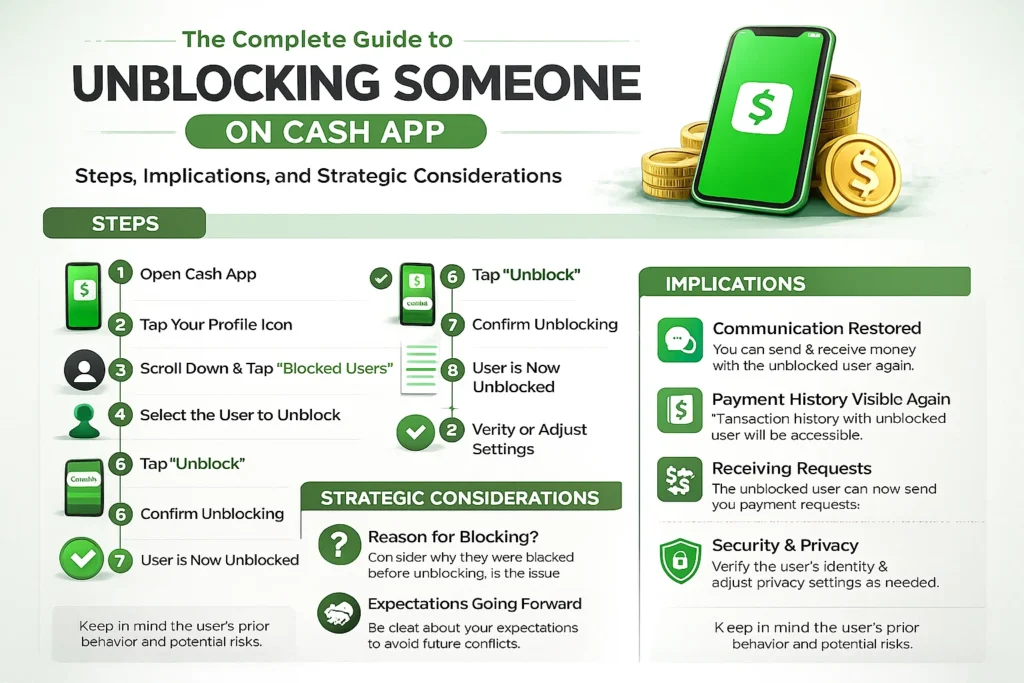
Part 2: The Step-by-Step Guide to Unblocking Someone on Cash App
The unblocking process is straightforward but buried within the app’s settings. Follow these steps carefully. Note: Screenshots and interface details may vary slightly between iOS and Android, but the menu structure is consistent.
Method 1: Unblocking Via the Privacy & Security Menu (Primary Method)
This is the most reliable and recommended method, accessed through your settings.
Launch the Cash App: Open the Cash App on your iPhone or Android device and ensure you are logged into the correct account.
Access Your Profile: Tap the profile icon in the top-right corner of the home screen (it may look like a person’s silhouette or your avatar).
Navigate to Privacy & Security: Scroll down the profile menu and select the option labeled “Privacy & Security.” This is the central hub for all access controls.
Find the Blocked List: Within the Privacy & Security menu, look for the section titled “Blocked Contacts,” “Blocked People,” or something very similar. Tap on it.
View and Select: You will now see a list of every Cash App user you have actively blocked. Scroll through this list to find the person you wish to unblock.
Execute the Unblock: Next to the person’s name and $Cashtag, you should see an “Unblock” button or option. Tap it.
Confirm the Action: A confirmation pop-up will typically appear, asking if you are sure you want to unblock this person. It may warn you that they will then be able to find your profile and send you requests. Confirm by tapping “Yes,” “Unblock,” or “Confirm.”
Verification: The user’s name should immediately disappear from your Blocked Contacts list. They are now unblocked.
Method 2: Unblocking Via Old Chat History (If Available)
If you still have the old conversation thread with the person you blocked, you can sometimes access the unblock function from there.
Go to Your Activity Feed: From the Cash App home screen (the clock/tab icon), find the old transaction or conversation with the blocked person.
Open the Conversation: Tap on the specific transaction thread.
Access Profile Options: Within the chat window, look for the user’s $Cashtag or name, often at the top. You may need to tap an info (i) icon or their profile image.
Find the Unblock Option: If available, there should be a clear “Unblock” option here. If you only see “Block,” it means they are not currently blocked.
Confirm: Follow the same confirmation prompts as in Method 1.
Important Note: If you have deleted the conversation from your Activity feed, this method will not be available. Always default to Method 1.
Part 3: What Does Unblocking Actually Restore? The Nuanced Reality
Unblocking someone is not a simple “undo” button. It’s important to manage your expectations and understand the restored capabilities.
What Unblocking DOES Restore:
Searchability: The user can now find your profile by searching for your $Cashtag, phone number, or email.
Transaction Permissions: They can once again send you payments and send you payment requests. You will also be able to send them money and requests.
Communication: The chat thread becomes active again. They can message you regarding transactions.
What Unblocking Does NOT Do:
It does NOT automatically re-add them as a contact. You will need to search for their $Cashtag and re-send a friend request or initiate a transaction to have them appear conveniently in your contacts list.
It does NOT restore any deleted transaction history. Any history you deleted before or during the block remains deleted.
It does NOT force a reconnection. The other user may have blocked you in return or simply may not attempt to contact you.
It does NOT provide any notification. The unblocked user is not alerted that you have unblocked them. They will only know if they try to search for you or send you money.
The “Gray Zone” – Pending Requests at the Time of Block:
A complex scenario arises if you had a pending payment request from someone when you blocked them. The system’s behavior can be inconsistent. Typically, the request may become void or stuck. After unblocking, you may need to cancel the old request and have them send a new one, or simply send them a fresh payment directly.
Part 4: Critical Considerations Before You Tap “Unblock”
Unblocking should be a deliberate decision, not an impulsive one. Ask yourself these questions:
Why Was This Person Blocked in the First Place?
If it was for Fraud/Scams: DO NOT UNBLOCK. This is a critical security rule. Re-establishing a connection with a known scammer puts you at immediate risk.
If it was a Personal Dispute: Have the core issues been resolved? Unblocking without resolving the problem may just lead to another uncomfortable financial interaction.
If it was an Accident: Proceed with the unblocking—this is the ideal use case.
Do You Need to Transact, or Just “Be Nice”? You can be civil with someone in life without having them on your financial apps. If there’s no concrete reason to exchange money, consider leaving the block in place for privacy.
Are You Prepared for Potential Contact? Unblocking opens the door for them to send you messages or payment requests. Be mentally prepared for that possibility.
Consider a Preliminary Step: If you’re unsure, you could message the person through another channel (text, social media) to discuss the issue before unblocking them on Cash App. This sets a boundary and ensures both parties are on the same page.
Part 5: Advanced Troubleshooting and FAQs
Q1: I unblocked someone, but I still can’t find them to send money. Why?
A: As mentioned, unblocking doesn’t re-add them. You must use the “Search” function (usually the magnifying glass icon on the home screen) and manually enter their exact $Cashtag, phone number, or email to find their profile and initiate a new transaction.
Q2: What if the person I unblocked has since blocked me?
A: You will encounter a one-sided barrier. You might be able to find their profile, but any attempt to send money or a request will fail or be met with a generic error. The system will not explicitly tell you that you are blocked. In this case, communication outside the app is the only solution.
Q3: Can I unblock someone from the Cash App website?
A: No. Cash App’s full functionality, especially privacy controls like blocking/unblocking, is only available on the official mobile apps for iOS and Android. The website is limited for viewing statements and basic account info.
Q4: Is there a limit to how many times I can block/unblock the same person?
A: Cash App does not publish a specific limit, but abusing the feature (rapidly blocking and unblocking) could be flagged as suspicious activity by their systems. Use the feature judiciously.
Q5: What are my alternatives to unblocking?
Use a Different Payment App: Suggest using Venmo, Zelle, or PayPal for a one-time transaction without unblocking on Cash App.
Send via a Trusted Intermediary: Have a mutual friend receive the money from you and send it to the other person.
Old-Fashioned Cash: Sometimes, the analog solution is best for complex digital relationships.
Part 6: Best Practices for Managing Your Cash App Ecosystem
To avoid the constant need to block and unblock, cultivate good habits:
Use $Cashtags Strategically: Your $Cashtag is your primary identifier. Make it unique and not easily guessable (e.g., avoid $JohnSmith).
Leverage the “Request” Feature Wisely: Only send payment requests to people you know and trust. Unsolicited requests are a red flag.
Review Privacy Settings Regularly: Periodically check your Blocked Contacts list to clean up old blocks that are no longer relevant.
Verify, Then Trust: Always confirm the identity of a person, especially for first-time transactions with strangers. A quick phone call or video confirmation can prevent fraud.
Think of Blocking as a Permanent Solution for Temporary Problems: Use it as a last resort for personal disputes, but as a first resort for suspected fraud.
Conclusion: Unblocking as an Act of Digital Financial Curation
Unblocking someone on Cash App is more than a technical process; it is an act of digital relationship management. It represents a decision to re-open a channel of financial trust and interaction. By understanding the full weight of the action—the restored capabilities, the lingering limitations, and the security implications—you empower yourself to navigate the social-financial hybrid world with confidence.
Remember, your payment app is an extension of your personal space. The block list is a tool to protect that space. Use it, and the power to reverse it, with thoughtful intention. Whether mending a fence with a friend or correcting an honest mistake, following this comprehensive guide ensures you perform the action correctly, safely, and with full awareness of the new financial landscape you are creating.