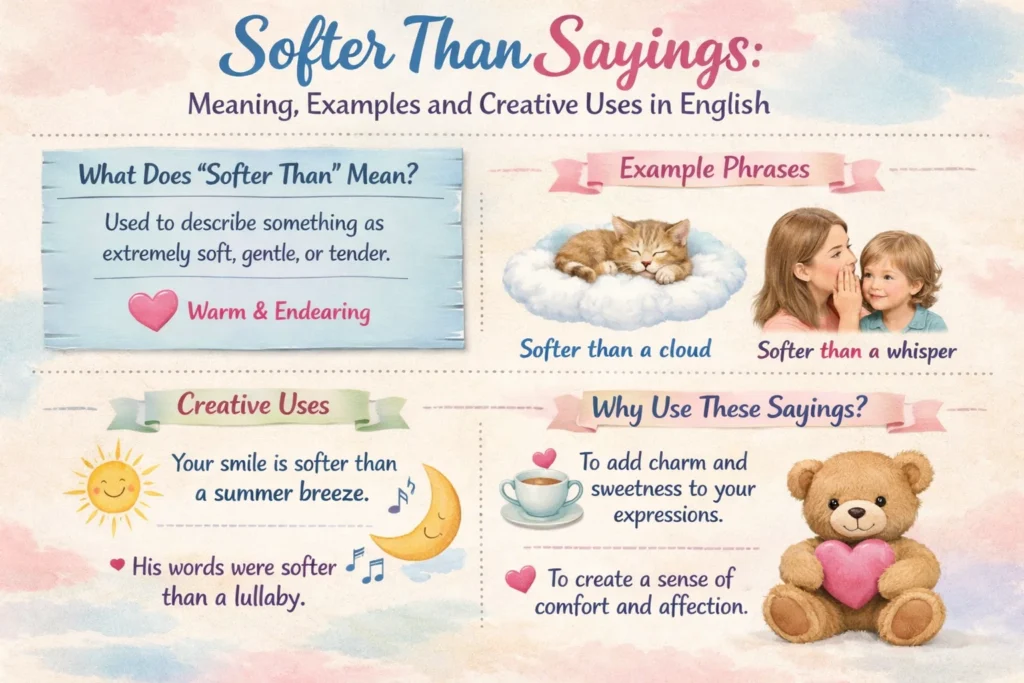

Language is powerful, and how we express ourselves often matters just as much as what we say. One interesting category of expressions in English is “softer than” sayings—phrases used to describe something as extremely gentle, smooth, delicate, quiet, or mild by comparing it to something universally known for softness.
Search interest in “softer than sayings” has grown among writers, poets, students, and social media users looking for creative, polite, or poetic ways to communicate ideas without sounding harsh. These sayings help soften tone, avoid offense, and add imagery to speech and writing.
This comprehensive guide explores the meaning, types, examples, origins, cultural significance, and modern usage of softer-than sayings, along with tips on how to use them effectively.
What Are “Softer Than” Sayings?
Softer than sayings are figurative expressions that use comparison to describe extreme softness, gentleness, or subtlety. They usually follow this structure:
“Softer than + something famously soft”
These sayings are part of similes, a common literary device that compares two things using “like” or “than.”
Simple Example
“Her voice was softer than silk.”
Here, silk represents smoothness and delicacy, making the description vivid and emotionally appealing.
Why Softer Than Sayings Are Popular
Softer-than sayings are widely used because they:
Create strong mental images
Add emotion and warmth to language
Reduce harshness in communication
Improve storytelling and poetry
Make speech more polite and expressive
In many cultures, especially in modern communication, people prefer gentle wording over blunt statements.
Common Softer Than Sayings in English
Here are some of the most widely used and recognized softer-than sayings:
Softer Than Silk
Used to describe:
Smooth voices
Luxurious fabric
Gentle touch
Example:
“Her words were softer than silk, calming everyone in the room.”
Softer Than Cotton
Used for:
Comfort
Warmth
Innocence
Example:
“The baby’s skin felt softer than cotton.”
Softer Than a Whisper
Used for:
Quiet sounds
Subtle communication
Example:
“He spoke softer than a whisper so no one else could hear.”
Softer Than a Feather
Used for:
Lightness
Delicacy
Example:
“Her steps were softer than a feather on the floor.”
Softer Than Butter
Used to describe:
Tender food
Easy persuasion
Gentle personalities
Example:
“Once you get to know him, he’s softer than butter.”
Creative and Poetic Softer Than Sayings
Writers and poets often invent unique softer-than sayings to create originality:
Softer than moonlight
Softer than falling snow
Softer than a summer breeze
Softer than dawn’s first light
Softer than a mother’s lullaby
These expressions are common in poetry, novels, and song lyrics.
Softer Than Sayings in Daily Conversation
In everyday speech, these sayings help maintain politeness and emotional sensitivity.
Examples in Conversation
“Try to speak softer than usual; the baby is sleeping.”
“She handled the situation softer than expected.”
“His tone was softer than before, showing regret.”
Such expressions help reduce conflict and improve understanding.
Softer Than Sayings in Writing and Literature
Authors use softer-than sayings to:
Build atmosphere
Develop characters
Create emotional depth
Literary Example
Instead of writing:
“She spoke quietly.”
A writer may choose:
“She spoke softer than falling snow.”
This adds imagery and emotion, making the scene more engaging.
Cultural Importance of Soft Language
Across cultures, soft language is associated with:
Respect
Wisdom
Emotional intelligence
Maturity
In many societies, speaking softly is seen as a sign of strength rather than weakness. Softer-than sayings support this cultural value by promoting gentle expression.
Softer Than Sayings vs Literal Language
Literal Language
Direct
Clear
Sometimes harsh
Softer Than Sayings
Figurative
Emotional
Polite and expressive
Example comparison:
Literal:
“He was very calm.”
Figurative:
“He was softer than the evening breeze.”
Modern Usage on Social Media
Softer-than sayings are popular on:
Instagram captions
Pinterest quotes
Poetry reels
TikTok storytelling videos
Popular Caption Examples
“Healing energy, softer than silence.”
“Choose words softer than fear.”
“Love should always be softer than ego.”
These sayings resonate with audiences seeking calm and positivity.
Softer Than Sayings in Relationships
In emotional communication, softer-than sayings help express care and empathy.
Examples
“I’ll explain it softer than before.”
“Her apology was softer than expected.”
“Love grows in moments softer than anger.”
They encourage emotional safety and understanding.
Educational Value of Softer Than Sayings
For students and English learners, these sayings:
Improve vocabulary
Teach figurative language
Enhance writing creativity
Develop emotional expression skills
Teachers often use them to explain similes and metaphors.
Creating Your Own Softer Than Sayings
You can create original softer-than sayings by following these steps:
Choose a quality (soft, gentle, calm)
Think of something universally associated with it
Make a comparison
Example
Softer than a cloud at sunset
Softer than rain on warm soil
Original sayings feel more personal and expressive.
Mistakes to Avoid
Overusing them in formal writing
Using confusing or unfamiliar comparisons
Mixing metaphors incorrectly
Balance is key—use softer-than sayings where emotion or imagery is needed.
Softer Than Sayings in Professional Writing
While mostly informal, they can be used carefully in:
Speeches
Motivational writing
Creative marketing content
Example:
“Our customer support approach is softer than traditional service models.”
Psychological Impact of Soft Language
Studies in communication psychology suggest that softer language:
Reduces stress
Improves cooperation
Encourages openness
Builds trust
Softer-than sayings contribute positively to emotional communication.
Why “Softer Than” Sayings Matter Today
In a fast-paced, often aggressive digital world, people crave:
Calmness
Kindness
Empathy
Softer-than sayings reflect a shift toward mindful and compassionate communication.
Frequently Asked Questions (FAQs)
What does “softer than sayings” mean?
It refers to expressions that describe gentleness or softness using comparisons.
Are softer-than sayings idioms?
Most are similes, not fixed idioms, but some have idiomatic usage.
Can I use them in essays?
Yes, especially in creative or descriptive writing.
Are they suitable for formal writing?
Use sparingly; they work best in informal or creative contexts.
Final Thoughts
Softer than sayings enrich the English language by offering gentle, expressive, and emotionally intelligent ways to communicate. Whether used in poetry, daily conversation, or digital content, these sayings allow speakers and writers to express subtlety, kindness, and depth.