
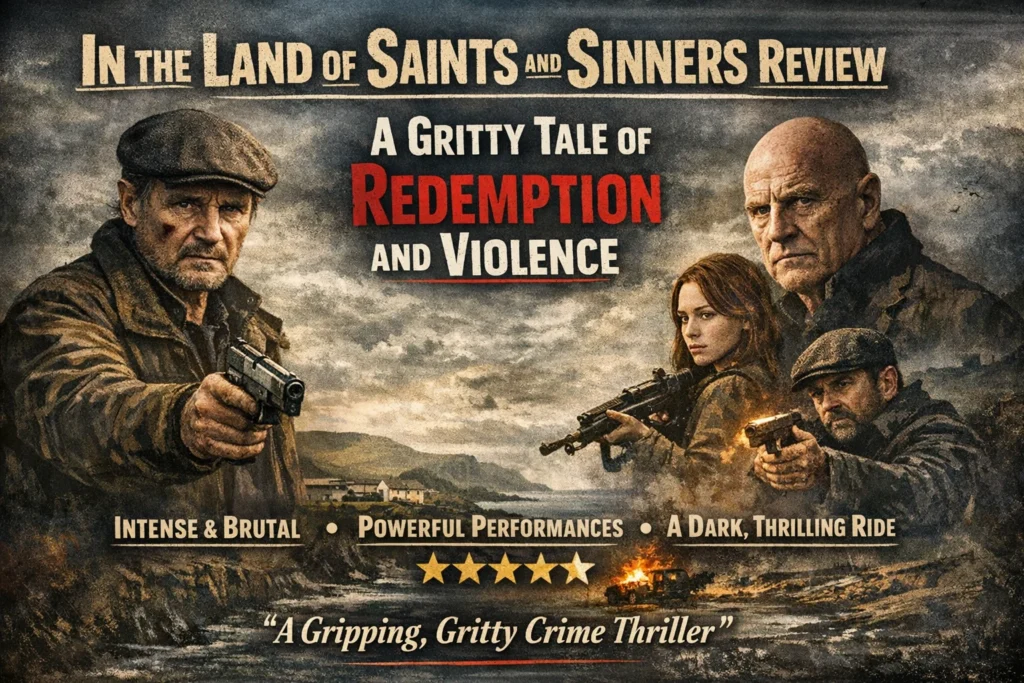

In the Land of Saints and Sinners is a slow-burn crime thriller that blends violence, morality, and redemption against the haunting backdrop of rural Ireland. Starring Liam Neeson in a role that feels both familiar and refreshingly restrained, the film explores what happens when a man trying to escape his violent past is forced to confront it one final time. Directed by Robert Lorenz, the movie stands out not because of explosive action, but because of its emotional weight, moral complexity, and atmospheric storytelling.
This review offers a deep, spoiler-light analysis of the film’s plot, performances, themes, direction, cinematography, and overall impact, explaining why In the Land of Saints and Sinners resonates as more than just another revenge thriller.
Overview of the Film
Title: In the Land of Saints and Sinners
Genre: Crime, Thriller, Drama
Director: Robert Lorenz
Starring: Liam Neeson, Kerry Condon, Ciarán Hinds, Jack Gleeson
Setting: Rural Ireland, 1970s
Tone: Dark, reflective, gritty
Release Period: Early 2020s
At its core, the film is a character study disguised as a crime thriller. While it contains moments of violence, its true strength lies in its emotional restraint and its exploration of guilt, aging, and the possibility of redemption.
Plot Summary (Spoiler-Light)
Set in a quiet coastal village in Ireland during the 1970s, In the Land of Saints and Sinners follows Finbar Murphy, an aging hitman who has spent decades committing acts of violence in service of criminal organizations. Tired, remorseful, and haunted by his past, Finbar decides it is time to retire and seek some semblance of peace.
He lives a modest life, blending into the community and trying to do small acts of good to balance the harm he has caused. However, his fragile calm is shattered when a group of violent extremists arrives in the village, bringing chaos, brutality, and innocent bloodshed.
When these newcomers threaten the safety of the people Finbar has grown to care about, he is faced with an impossible choice: remain silent and preserve his fragile peace, or return to the violence he despises to protect others.
The story unfolds slowly, allowing tension to build naturally, leading to a final act that is emotionally heavy rather than purely action-driven.
Liam Neeson’s Performance
Liam Neeson delivers one of his most restrained and emotionally grounded performances in years. Unlike his fast-paced action roles, Finbar Murphy is a quiet, weary man whose strength lies in stillness rather than aggression.
Key Strengths of His Performance
Subtle facial expressions that convey regret and exhaustion
Minimal dialogue, allowing silence to speak volumes
A believable portrayal of an aging man grappling with his violent legacy
Neeson’s performance is less about physical dominance and more about moral conflict. He plays Finbar not as a hero, but as a deeply flawed man seeking forgiveness in a world that refuses to let him forget who he once was.
Supporting Cast and Performances
Kerry Condon
Kerry Condon provides emotional warmth and humanity to the film. Her character represents compassion, resilience, and moral clarity, serving as a quiet counterbalance to Finbar’s violent past. She grounds the film emotionally and adds depth to the village’s sense of community.
Jack Gleeson
Best known for his role as Joffrey Baratheon in Game of Thrones, Jack Gleeson delivers a chilling performance as one of the antagonists. His portrayal is unsettling not because of exaggerated cruelty, but because of its cold realism. He embodies ideological extremism with disturbing calm.
Ciarán Hinds
Ciarán Hinds brings gravitas and complexity to his role, adding layers of tension and emotional history. His presence reinforces the film’s themes of loyalty, betrayal, and moral compromise.
Direction and Storytelling
Director Robert Lorenz takes a deliberate, patient approach to storytelling. Rather than relying on fast pacing or constant action, he allows scenes to breathe, giving the audience time to absorb the emotional weight of each moment.
Direction Highlights
Thoughtful use of silence
Minimalist dialogue
Focus on character over spectacle
Lorenz’s direction respects the intelligence of the audience, trusting viewers to connect the emotional dots without excessive exposition.
Cinematography and Visual Atmosphere
The cinematography is one of the film’s greatest strengths. The rugged Irish coastline, misty landscapes, and muted color palette create an atmosphere that is both beautiful and melancholic.
Visual Elements
Wide shots emphasizing isolation
Natural lighting for realism
Muted tones reflecting moral ambiguity
The setting feels like a character in its own right, reinforcing the themes of loneliness, memory, and buried violence.
Themes and Symbolism
Redemption and Guilt
The film’s central theme is redemption. Finbar is not seeking forgiveness from others as much as he is seeking it from himself. The story asks whether good deeds can ever truly erase past sins.
Violence as a Cycle
Rather than glorifying violence, the film portrays it as a destructive cycle that leaves lasting scars. Every act of brutality carries consequences, both for victims and perpetrators.
Aging and Mortality
Finbar’s age plays a significant role in the narrative. The film reflects on what it means to grow old with regret, and whether it is ever too late to choose a different path.
Community vs Isolation
The contrast between the warmth of the village and the cold brutality of the antagonists highlights the importance of human connection and shared values.
Pacing and Structure
The pacing is intentionally slow, which may not appeal to viewers expecting a traditional action thriller. However, this deliberate rhythm allows the emotional stakes to develop organically.
Strengths of the Slow Burn
Builds tension naturally
Enhances character depth
Makes moments of violence more impactful
Rather than overwhelming the viewer with constant action, the film uses restraint to make its climactic moments feel earned.
Music and Sound Design
The soundtrack is subtle and understated, complementing the film’s tone rather than overpowering it. Silence is often used more effectively than music, heightening tension and emotional impact.
The sound design emphasizes realism—footsteps, wind, distant waves—creating an immersive viewing experience.
Comparison to Other Liam Neeson Films
Unlike films such as Taken or The Commuter, In the Land of Saints and Sinners is not driven by adrenaline. It is closer in spirit to films like Calvary or A History of Violence, where moral questions take precedence over spectacle.
This film marks a mature evolution in Neeson’s career, showing his ability to carry a story through emotional depth rather than physical action alone.
Strengths of the Film
Powerful lead performance
Rich thematic depth
Atmospheric cinematography
Strong supporting cast
Thoughtful, mature storytelling
Weaknesses of the Film
Slow pacing may not suit all audiences
Limited action compared to typical thrillers
Some characters could have been explored further
Despite these minor drawbacks, the film remains compelling for viewers who appreciate character-driven narratives.
Audience Reception and Critical Response
The film has been praised for:
Its mature tone
Strong performances
Emotional storytelling
Some critics noted that the slow pace might limit its mainstream appeal, but many agreed that its emotional resonance sets it apart from conventional genre films.
Who Should Watch This Film?
This movie is ideal for:
Fans of slow-burn crime dramas
Viewers interested in moral and philosophical themes
Liam Neeson fans seeking a deeper, more reflective role
Audiences who appreciate atmospheric storytelling
Those expecting fast-paced action may find it less satisfying, but patient viewers will be rewarded.
Final Verdict
In the Land of Saints and Sinners is a haunting, thoughtful film that explores the cost of violence and the fragile hope of redemption. Anchored by a powerful, understated performance from Liam Neeson, it is a story about facing the past, protecting the innocent, and finding meaning in one’s final choices.
Rather than offering easy answers, the film invites viewers to reflect on morality, forgiveness, and the weight of human actions. It may not be loud or flashy, but its quiet intensity lingers long after the credits roll.