
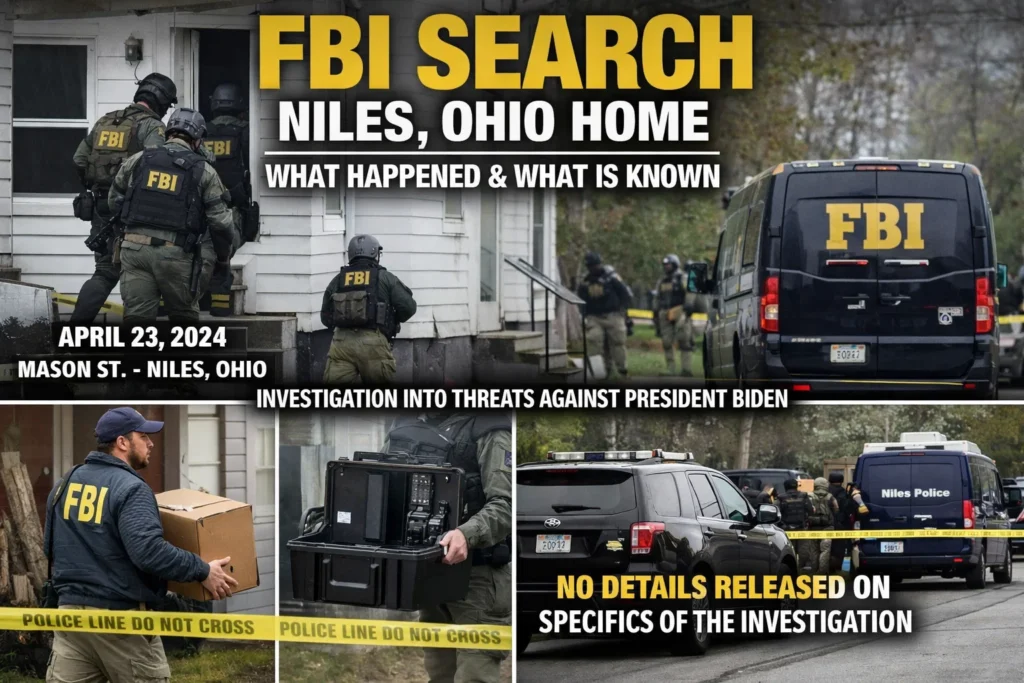

When federal law enforcement — especially the Federal Bureau of Investigation (FBI) — conducts a search of a private residence, it attracts attention. A search warrant executed at a home in Niles, Ohio sparked local curiosity and concern, prompting many people to search online for details about the event, what it means, and whether there is a threat to public safety. This article explains what’s publicly known about the FBI’s search activity in Niles, how these types of operations typically work, the legal framework behind search warrants, and why local residents and observers should put news reports into context.
What Happened in Niles, Ohio?
In late January 2025, news outlets reported that FBI agents had conducted a raid at a home in Niles, Ohio — specifically on the 400 block of North Bentley Avenue. Local news crews saw unmarked law enforcement vehicles at the residence, and the FBI stated that the activity was “court-authorized law enforcement activity”. Local reporters confirmed that the agency executing the operation was federal, and that there was no immediate threat to the public according to an FBI spokesperson.
The specific reason for the search was not publicly disclosed in the initial reports. Law enforcement agencies often withhold details early in investigations, especially when indictments or arrests have not yet been made public.
A local YouTube video from WKBN-TV 27 also showed footage of the FBI presence at the scene on Bentley Avenue in Niles, further confirming that federal agents were involved in the search operation.
What Does “Court-Authorized Activity” Mean?
When reporters describe an FBI search as “court-authorized,” it means:
A search warrant was signed by a judge or magistrate, based on sworn evidence presented by law enforcement.
The warrant must outline the location to be searched and often the type of evidence investigators seek.
A federal judge only approves a warrant if there is probable cause to believe that evidence of a crime will be found in the specified place.
Federal search warrants are governed by the Fourth Amendment to the U.S. Constitution, which protects people from unreasonable searches and seizures. Law enforcement must demonstrate probable cause to obtain a warrant. Once issued, the FBI can execute the warrant at the designated location.
Because the online reports from Niles did not include the affidavit or probable cause statement, the specific basis for the search remains undisclosed to the public at this time.
Why FBI Searches Sometimes Make Headlines
Federal search warrants are newsworthy for several reasons:
They involve potential criminal investigations ranging from white-collar crime to violent offenses.
They involve federal authority, not just local police.
They may signal broader investigations that could lead to charges or indictments.
They raise public safety and legal questions for communities where they occur.
Even when media reports lack details, the mere presence of federal agents often leads people to wonder what prompted the action and whether it involves serious criminal allegations.
What the Public Has Not Been Told (and Why)
In the case of the Niles search:
The exact nature of the investigation has not been confirmed in public reporting.
No charges or names were released in the initial reports.
Law enforcement typically withholds details until the case progresses — particularly where suspects’ rights could be affected.
This is standard practice in ongoing federal investigations and does not necessarily mean anything unusual beyond procedural caution.
Historical Context: FBI Searches in Ohio
Searches by the FBI and law enforcement are not unique to Niles. There have been multiple past instances of FBI search warrants executed at homes and businesses across Ohio in relation to federal investigations. For example, agents executed a warrant at a home in Boardman, Ohio as part of an unspecified investigation in early 2025, and they have conducted other court-authorized activities in northern Ohio.
These operations can cover a wide range of federal crimes, from fraud and drug trafficking to violent crimes or violations of federal law enforcement statutes.
The FBI Cleveland Field Office and Its Role in Northern Ohio
The FBI’s Cleveland Field Office is responsible for much of northern Ohio, including areas like Niles. It works with local law enforcement agencies, federal prosecutors, and other partners to investigate crimes under federal jurisdiction.
The territory covers cities and communities throughout northern Ohio, and the office frequently issues public alerts, tip requests, and operational notice about investigations and ongoing law enforcement activities.
Legal Framework: Search Warrants and Civil Liberties
To understand these events fully, it’s helpful to know how search warrants function within U.S. law:
A search warrant must be issued by a neutral judge based on probable cause.
Warrants must describe places to be searched and items to be seized.
Law enforcement cannot search a home without a warrant unless there are exigent circumstances — such as an immediate risk to safety or destruction of evidence.
The Fourth Amendment protects individuals from arbitrary search and seizure, requiring law enforcement to justify their actions legally and transparently to a judge.
This framework exists to balance public safety with individual rights.
Why Details Aren’t Always Public Immediately
Media may report that a federal search took place, but:
Investigators may be gathering evidence for an ongoing case.
Charges may not yet be filed, preventing public disclosure.
Prosecutors may file sealed documents until sufficient evidence is available.
In many federal investigations, sealed indictments or ongoing grand jury proceedings delay public disclosure of the specifics.
Community Impact and Public Reactions
When a federal search happens in a residential neighborhood, residents often react in three broad ways:
- Concern About Public Safety
Neighbors may worry about violent crime or danger, but agents conducting searches are trained to assess risk and ensure public safety first.
- Curiosity and Speculation
Lack of publicly released details often leads to speculation online and in community groups — but speculation should be tempered by facts.
- Respect for Due Process
Federal investigations may take time, and people involved are presumed innocent until proven guilty in court.
Local news coverage in Niles noted that there was no immediate threat to public safety related to the FBI action.
Similar FBI Activities Elsewhere (Context)
While not directly connected, similar search warrant executions appear in other jurisdictions, such as federal raids on homes in Dearborn, Michigan, during investigations into serious crimes.
These examples underscore the FBI’s role in enforcing federal law across the United States, whether the focus is organized crime, terrorism, child exploitation, financial fraud, or other major offenses.
How Residents Can Stay Informed
If you live in an area where federal law enforcement activity occurs, consider these ways to stay informed responsibly:
Follow verified local news outlets for updates.
Avoid spreading unverified rumors or speculation online.
Check official statements from law enforcement or government offices.
Understand that details may not be public until formal charges are filed.
News reporting after these incidents often continues as cases develop and prosecutors make filings in federal court.
Frequently Asked Questions (FAQs)
Was Anyone Arrested During the FBI Search in Niles?
At the time of initial reporting, no arrests were confirmed or announced publicly. Federal investigations may lead to charges later if prosecutors file indictments.
Is the Public in Danger?
Local law enforcement and FBI statements indicated that there was no immediate danger to the public related to the search.
Why Didn’t Officials Release More Details?
Investigations are legally sensitive. Details are often withheld until charges or indictments are filed to protect the integrity of the case and the rights of individuals involved.
Can Search Warrants Be Challenged in Court?
Yes. If evidence is obtained improperly, defense attorneys can file motions to suppress evidence based on constitutional grounds under the Fourth Amendment.
Conclusion
FBI searches of private homes — such as the one reported in Niles, Ohio — are relatively rare events that attract public attention due to the federal nature of the agency and the serious legal processes involved. From what has been reported, agents executed a court-authorized search warrant at a Niles residence, and law enforcement publicly stated there was no immediate threat to the community.
While the specific reasons for the search were not disclosed, understanding the legal framework behind search warrants, the role of the FBI’s Cleveland Field Office, and how federal investigations operate helps put these events into context without speculation. Keeping informed through reputable news sources and official statements ensures that community members understand such developments responsibly and accurately.