
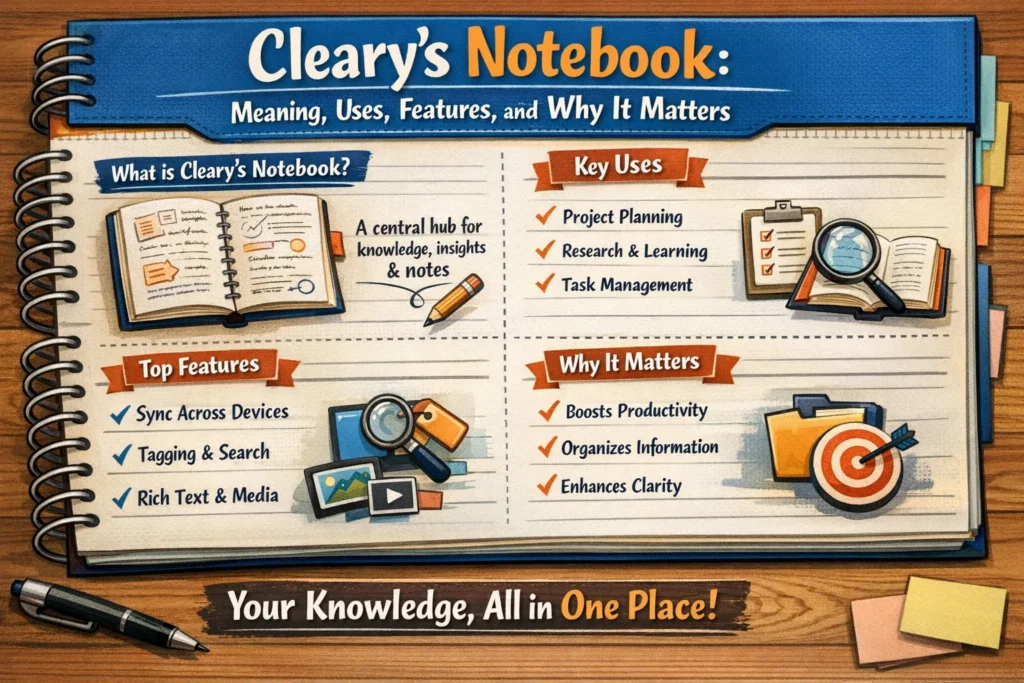

In a world overwhelmed by information, people are constantly searching for better ways to organize ideas, learning, and thoughts. From students and teachers to writers, researchers, and professionals, everyone needs a system that helps turn scattered information into clear understanding. This is where Cleary’s Notebook comes into focus.
Cleary’s Notebook is not just a notebook in the traditional sense. Instead, it represents a method, concept, or approach to note-taking and documentation that emphasizes clarity, structure, reflection, and meaningful organization of information. The growing interest in Cleary’s Notebook shows how valuable intentional note-keeping has become in modern education, productivity, and personal development.
This article provides a complete and in-depth guide to Cleary’s Notebook, explaining what it is, where the idea comes from, how it is used, its benefits, and why it remains relevant in today’s digital world.
What Is Cleary’s Notebook?
Cleary’s Notebook refers to a systematic way of recording information that prioritizes clear thinking, structured notes, and reflective understanding. Rather than simply writing down everything word for word, this approach focuses on:
Identifying key ideas
Organizing information logically
Adding personal insights and reflections
Making notes useful for long-term reference
In simple terms, Cleary’s Notebook is about thinking clearly through writing clearly.
The Idea Behind Cleary’s Notebook
The concept behind Cleary’s Notebook is rooted in the belief that writing improves thinking. When notes are structured and intentional, the mind processes information more deeply.
Unlike casual note-taking, where information is often forgotten soon after writing, Cleary’s Notebook encourages:
Understanding instead of copying
Reflection instead of repetition
Meaning instead of memorization
This makes it a powerful tool for learning and knowledge management.
Historical Inspiration of Notebook Systems
Throughout history, notebooks have played a key role in human progress. Famous thinkers like Leonardo da Vinci, Charles Darwin, and Marie Curie relied on notebooks to document ideas, experiments, and observations.
Cleary’s Notebook fits into this tradition but adapts it for modern needs by emphasizing:
Clear organization
Purpose-driven writing
Practical usability
It blends classical notebook wisdom with contemporary productivity principles.
Purpose of Cleary’s Notebook
The main purpose of Cleary’s Notebook is to transform information into understanding. It is designed to help users:
Learn more effectively
Retain information longer
Think critically
Reflect deeply
Stay organized
Whether used in education, work, or personal life, the goal remains the same: clarity.
Core Features of Cleary’s Notebook
- Clear Structure
Cleary’s Notebook follows a structured format, often including:
Titles and headings
Bullet points
Sections and sub-sections
This makes notes easier to read and review.
- Focus on Key Ideas
Instead of recording everything, users extract:
Main concepts
Supporting points
Important examples
This helps reduce information overload.
- Reflection and Interpretation
One of the defining features is reflection. Users are encouraged to add:
Personal thoughts
Questions
Connections to other ideas
Reflection turns notes into knowledge.
- Flexibility
Cleary’s Notebook can be:
A physical notebook
A digital document
A note-taking app system
The method adapts to different tools and preferences.
Cleary’s Notebook vs Traditional Note-Taking
Aspect Traditional Notes Cleary’s Notebook
Organization Often messy Highly structured
Focus Copying information Understanding meaning
Reflection Rare Essential
Long-term use Limited High value
This comparison highlights why many people prefer a more thoughtful system.
Uses of Cleary’s Notebook
- Education and Academic Learning
Students can use Cleary’s Notebook to:
Summarize lectures
Organize study material
Prepare for exams
Improve comprehension
It supports active learning, which research shows is more effective than passive note-taking.
- Research and Study
Researchers benefit from Cleary’s Notebook by:
Documenting observations
Tracking sources
Structuring complex ideas
Developing arguments
This makes research more manageable and systematic.
- Writing and Creativity
Writers and creatives use it for:
Brainstorming ideas
Developing storylines
Recording inspiration
Refining concepts
The clarity of structure helps creativity flow without chaos.
- Professional and Workplace Use
In professional settings, Cleary’s Notebook helps with:
Meeting notes
Project planning
Skill development
Strategic thinking
It improves productivity and decision-making.
- Personal Growth and Reflection
Many people use Cleary’s Notebook as:
A reflective journal
A goal-tracking system
A self-development tool
Writing regularly enhances self-awareness.
Benefits of Using Cleary’s Notebook
Improved Thinking Skills
Clear writing leads to clear thinking.
Better Memory Retention
Structured notes are easier to recall.
Increased Focus
Writing with intention reduces distraction.
Long-Term Knowledge Storage
Notes remain useful over time.
Reduced Information Overload
Only important ideas are recorded.
How to Create Your Own Cleary’s Notebook
Step 1: Choose Your Medium
Decide between:
Paper notebook
Digital tools
Step 2: Create a Simple Structure
Use sections like:
Topic
Key ideas
Examples
Reflections
Step 3: Write in Your Own Words
Avoid copying without understanding.
Step 4: Review and Update
Revisit notes to reinforce learning.
Digital Tools That Support Cleary’s Notebook
Popular tools include:
Notion
Evernote
OneNote
Google Docs
These platforms allow easy organization and searching.
Why Cleary’s Notebook Is Important in the Digital Age
Today’s world is filled with constant information. Cleary’s Notebook helps by:
Reducing mental clutter
Improving understanding
Supporting mindful learning
It aligns perfectly with modern productivity and learning trends.
Common Misunderstandings About Cleary’s Notebook
“It’s Too Complicated”
In reality, it simplifies learning.
“It’s Only for Students”
Professionals and creatives benefit too.
“It Takes Too Much Time”
It saves time in the long run.
Cleary’s Notebook and Modern Learning
Cleary’s Notebook supports:
Critical thinking
Active learning
Knowledge management
Lifelong education
These skills are essential in today’s world.
Tips to Use Cleary’s Notebook Effectively
Keep notes concise
Use bullet points
Add personal reflections
Review regularly
Stay consistent
Consistency brings results.
Who Should Use Cleary’s Notebook?
Cleary’s Notebook is ideal for:
Students
Teachers
Writers
Researchers
Professionals
Lifelong learners
Anyone who values clarity will benefit.
Final Thoughts
Cleary’s Notebook is more than a note-taking method—it is a thinking tool. It encourages clarity, reflection, and intentional learning. In an age where information is everywhere, the ability to organize and understand it is a powerful advantage.
By adopting the principles of Cleary’s Notebook, individuals can improve learning, productivity, and creativity in meaningful ways.