
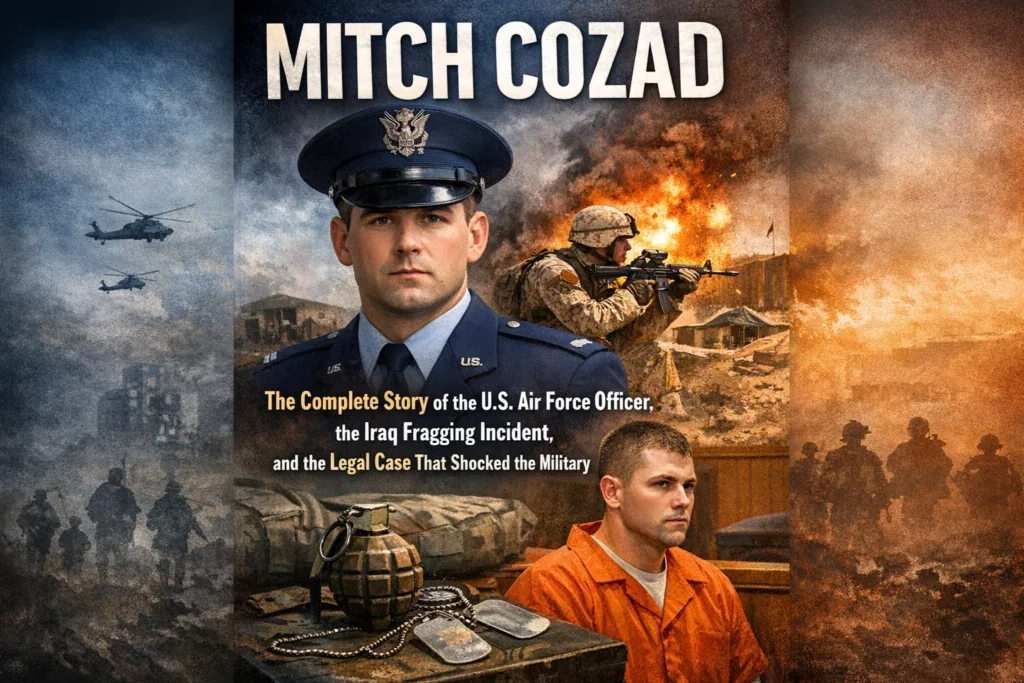

Military history contains many stories of bravery, sacrifice, and discipline. However, there are also moments when internal conflict within the armed forces creates controversy and raises serious questions about leadership, accountability, and justice.
One such case involves Mitch Cozad, a United States Air Force officer who became widely known after a shocking incident in Iraq in 2005. The case involved allegations of an attempted murder of a fellow officer during combat operations, leading to one of the most controversial military trials of the Iraq War era.
The story of Mitch Cozad is not only about a criminal investigation but also about military culture, leadership struggles, and the complicated nature of justice within the armed forces.
This detailed guide explores Mitch Cozad’s background, military career, the Iraq incident, the investigation, the court-martial, and the long-term impact of the case on the U.S. military.
Early Life and Background
Before the controversy that made his name widely known, Mitch Cozad lived a relatively ordinary life.
Although much of his early personal life remains private, it is known that Cozad pursued a path toward military service and leadership from a young age.
Like many future officers, he joined the United States Air Force with the goal of serving his country and building a career in military aviation and leadership.
Officers entering the Air Force typically undergo rigorous training and education, often through programs such as United States Air Force Academy or officer training schools.
This process prepares them for leadership responsibilities in both combat and administrative roles.
Military Career in the U.S. Air Force
After completing his training, Mitch Cozad began serving as an officer in the United States Air Force.
Air Force officers can work in various roles, including:
Pilot operations
Intelligence analysis
Tactical coordination
Base administration
Command leadership
Cozad served in a leadership role that involved coordinating military operations in conflict zones.
Like many U.S. service members during the early 2000s, he was eventually deployed to Iraq during the Iraq War.
The Iraq War placed intense pressure on military personnel, particularly those serving in leadership positions responsible for operational planning and decision-making.
Deployment to Iraq
In 2005, Mitch Cozad was stationed at Balad Air Base, one of the largest and most strategically important bases used by coalition forces during the Iraq War.
Balad Air Base served as a major hub for:
Air operations
Intelligence gathering
Command coordination
Combat support missions
Life on such bases involved long hours, high-stress situations, and complex relationships among officers and enlisted personnel.
These conditions sometimes created tension among military staff.
It was in this environment that the event that would define Mitch Cozad’s legacy occurred.
The Fragging Incident
On the night of March 2005, a shocking incident took place at Balad Air Base.
Cozad allegedly fired his weapon at fellow Air Force officer Jonathan J. Smith.
The shooting occurred inside a military tent where both officers were stationed.
Smith survived the attack but suffered serious injuries.
The incident was immediately treated as a potential “fragging” case, a term used in military contexts to describe a soldier attacking a fellow service member, often due to personal conflict or leadership disputes.
Fragging incidents are extremely rare in modern professional militaries but historically gained attention during the Vietnam War, when internal tensions sometimes led to violence between soldiers.
Motive Behind the Shooting
Investigators quickly began examining the relationship between Cozad and Smith.
Reports suggested that Smith had written a negative performance evaluation about Cozad shortly before the shooting.
In military structures, performance evaluations are extremely important because they affect:
Promotions
Career advancement
Command opportunities
Reputation within the military hierarchy
According to investigators, Cozad may have believed the evaluation would harm his career.
Prosecutors argued that the shooting was a deliberate attempt to silence Smith before the evaluation could damage his professional future.
Cozad, however, denied intentionally targeting Smith.
Investigation by Military Authorities
After the shooting, the case was investigated by the United States Air Force Office of Special Investigations.
The investigation focused on several key questions:
Was the shooting intentional?
Was it an act of attempted murder?
Could it have been accidental?
What evidence connected Cozad to the attack?
Military investigators collected evidence including:
Witness statements
Ballistic analysis
Forensic evidence
Communications records
The investigation quickly attracted attention because violent incidents between officers were extremely rare.
The Court-Martial Trial
Mitch Cozad eventually faced a court-martial, the military’s legal system for prosecuting service members accused of crimes.
Court-martial trials are conducted under the Uniform Code of Military Justice (UCMJ) and function similarly to civilian criminal courts.
The trial included:
Prosecutors representing the military
Defense attorneys representing Cozad
Military judges
Witness testimony
Prosecutors argued that the shooting was premeditated and motivated by the negative performance report written by Smith.
The defense, however, argued that the evidence was not strong enough to prove intentional attempted murder.
The Verdict
After reviewing the evidence, the court-martial panel ultimately acquitted Mitch Cozad of attempted murder charges.
The verdict shocked many observers because the case had appeared strong from the prosecution’s perspective.
However, military courts require proof beyond a reasonable doubt, and the panel determined that prosecutors had not met that standard.
The decision sparked debate about:
Military justice procedures
Evidence requirements
Accountability among officers
Reaction Within the Military
The case triggered strong reactions within the U.S. military community.
Some officers believed the verdict demonstrated that the military justice system was fair and required solid evidence before convicting someone.
Others believed the acquittal raised concerns about how serious crimes between service members were handled.
Because fragging incidents are so rare, the case received intense scrutiny.
Media Coverage
The Mitch Cozad case received attention from major media outlets and military publications.
Journalists covered the story because it involved:
A rare violent incident between officers
A dramatic attempted murder allegation
A controversial acquittal
The case also highlighted the pressures faced by military personnel serving in war zones.
The Psychological Pressure of War
Military experts often point out that combat deployments can place enormous psychological strain on service members.
Factors contributing to stress include:
Long deployments away from family
High operational tempo
Fear of attack
Leadership responsibilities
Career pressure
While these factors do not excuse violent behavior, they can contribute to conflicts within military units.
Fragging in Military History
Although rare today, fragging has occurred in military history.
During the Vietnam War, hundreds of fragging incidents were reported.
These cases often involved soldiers attacking officers they believed were incompetent or reckless.
Modern military leadership has worked extensively to eliminate such incidents through stronger discipline, leadership training, and psychological support systems.
Legal Lessons from the Case
The Mitch Cozad case revealed several important lessons about military justice.
Evidence Standards
Military courts must meet the same legal standard as civilian courts—proof beyond a reasonable doubt.
Investigative Challenges
Investigating crimes in combat zones can be extremely difficult due to:
Limited forensic resources
Security risks
Conflicting witness accounts
Leadership Accountability
The case sparked discussions about leadership relationships and evaluation systems within the military.
Life After the Trial
Following his acquittal, Mitch Cozad’s life became far less public.
Many details about his later career remain private.
Military officers involved in controversial cases often face long-term reputational challenges even if they are legally cleared.
Because the case was widely reported, Cozad’s name continues to be associated with the Iraq fragging incident.
Broader Impact on the U.S. Military
The case led to discussions within the United States Department of Defense about leadership evaluations, conflict resolution, and officer relationships.
Military organizations continuously review policies to prevent internal conflicts from escalating into violence.
Public Interest in the Case
Even years later, the Mitch Cozad case continues to generate interest among readers researching:
Military legal cases
Iraq War history
Fragging incidents
controversial military trials
It is often discussed in academic studies examining the psychological pressures faced by military officers in war zones.
Conclusion
The story of Mitch Cozad remains one of the most unusual and controversial cases in modern U.S. military history.
What began as a violent incident at Balad Air Base evolved into a high-profile court-martial that raised complex questions about evidence, leadership conflict, and justice during wartime.
Although the court ultimately acquitted Cozad of attempted murder, the case continues to be studied and discussed as an example of the challenges involved in investigating and prosecuting crimes in combat environments.
It also highlights the importance of maintaining discipline, communication, and accountability within military organizations.
As history continues to examine the events of the Iraq War, the Mitch Cozad case remains a reminder that even within structured institutions like the military, human conflict and controversy can arise.