
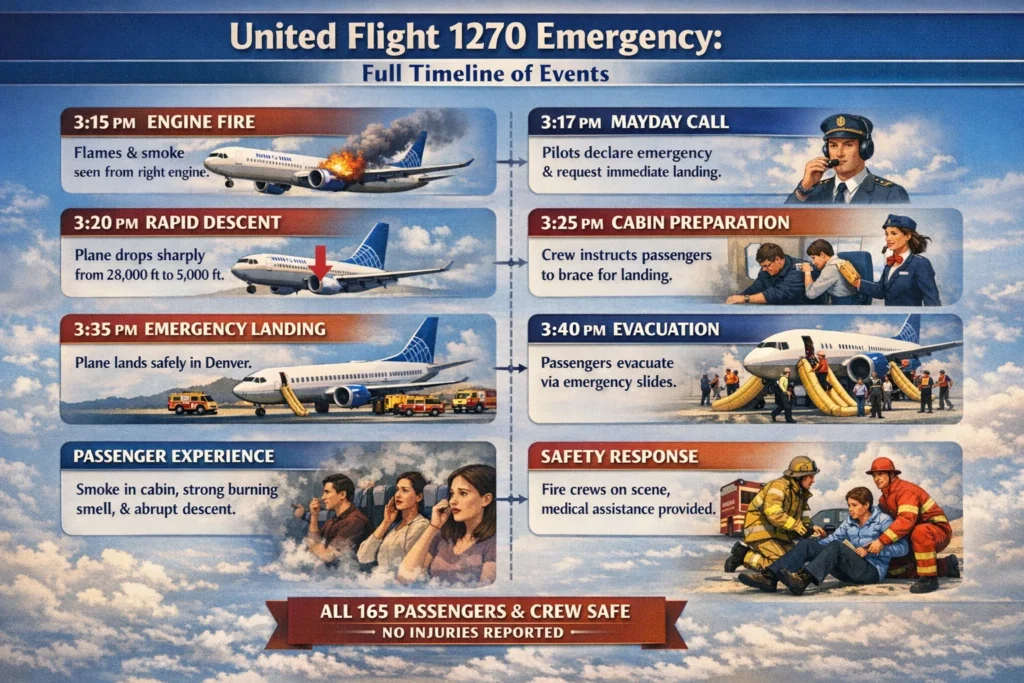

Air travel is widely regarded as one of the safest forms of transportation in the modern world. However, even with strict safety standards and advanced aircraft technology, unexpected incidents can still occur during flights. One such incident that attracted significant public attention was the United Flight 1270 emergency, which involved a mid-air technical problem that forced the crew to declare an emergency and prioritize a safe landing.
The event highlights how aviation safety procedures work in real-life situations. From the moment a technical problem is detected to the coordination between pilots, air traffic control, and ground emergency services, every step is carefully designed to protect passengers and crew.
This article provides a detailed explanation of the United Flight 1270 emergency, including what happened during the flight, how the pilots handled the situation, passenger reactions, aviation safety protocols, and the broader implications for airline safety.
Background of United Airlines
United Airlines is one of the largest airlines in the world and a major airline in the United States. Founded in 1926, the airline operates thousands of flights every day across domestic and international routes.
Key Facts About United Airlines
Headquarters: Chicago, Illinois
Founded: 1926
Fleet Size: Hundreds of aircraft including Boeing and Airbus models
Global Destinations: Over 300 cities worldwide
Alliance Membership: Star Alliance
United Airlines operates numerous daily flights connecting major global cities. With millions of passengers traveling annually, the airline maintains strict operational and safety procedures.
Overview of the United Flight 1270 Emergency
The United Flight 1270 emergency occurred shortly after the aircraft departed from its origin airport and was climbing toward cruising altitude.
Key Details
Airline: United Airlines
Flight Number: UA1270
Aircraft Type: Boeing commercial jet
Route: Chicago to Punta Cana
Issue: Mechanical problem detected mid-flight
Action Taken: Emergency declared using squawk code 7700
Outcome: Aircraft diverted and landed safely
According to reports, the crew detected a potential mechanical problem while the plane was climbing. As a precaution, the pilots declared an emergency to ensure priority assistance from air traffic control.
Timeline of the Emergency
- Normal Takeoff
The flight departed from Chicago as scheduled. Weather conditions were normal, and passengers boarded the aircraft without any unusual events.
During the early phase of the flight:
The aircraft climbed to cruising altitude
Cabin service had begun
Passengers settled into the flight
For the first part of the journey, everything appeared normal.
- Technical Issue Detected
As the aircraft continued climbing, the pilots noticed an abnormal mechanical indication on the aircraft systems.
Possible issues reported in such situations include:
Engine irregularities
Electrical system warnings
Hydraulic pressure alerts
Environmental control system problems
Because aircraft systems are highly monitored, even small anomalies can trigger warnings in the cockpit.
- Emergency Declaration
After identifying the issue, the pilots declared an emergency using the international distress code “7700.”
What is Squawk 7700?
In aviation, squawk codes are special signals transmitted from an aircraft transponder to air traffic control.
Important codes include:
7500 – Hijacking
7600 – Radio communication failure
7700 – General emergency
When the pilots set the transponder to 7700, it immediately alerts air traffic control that the aircraft needs urgent assistance.
This allows controllers to:
Clear other aircraft from the area
Provide priority landing clearance
Alert emergency responders at airports
Actions Taken by the Flight Crew
Commercial airline pilots are trained extensively for emergency situations. In the case of the United Flight 1270 incident, the crew followed standard aviation procedures.
Step-by-Step Response
Identify the problem through cockpit alerts
Inform air traffic control
Declare emergency using squawk 7700
Reduce altitude if necessary
Prepare the aircraft for diversion
Brief cabin crew and passengers
Pilots regularly train in flight simulators to handle exactly these kinds of emergencies.
Passenger Experience During the Emergency
For passengers, unexpected flight incidents can be frightening, especially when they notice unusual changes during the flight.
Passengers on United Flight 1270 reportedly experienced:
Announcement from the captain
Change in flight altitude
Aircraft turning back toward an airport
Cabin crew preparing passengers for landing
Despite the stressful situation, passengers generally reported that the crew remained calm and professional.
Flight attendants play a critical role during such situations. Their responsibilities include:
Communicating with passengers
Preparing the cabin for emergency landing
Ensuring seat belts are fastened
Reviewing evacuation procedures
Emergency Landing
After declaring the emergency, the flight diverted to the nearest safe airport.
Key steps in the landing process include:
- Emergency Preparation
Airport authorities prepare emergency vehicles such as:
Fire trucks
Ambulances
Rescue teams
These units wait near the runway as a precaution.
- Controlled Descent
Pilots gradually descend the aircraft to a safe altitude while monitoring system performance.
- Safe Landing
The plane lands with priority clearance, meaning other aircraft are delayed to ensure a safe approach.
Fortunately, the United Flight 1270 aircraft landed safely without serious injuries reported.
Aircraft Safety Systems
Modern commercial aircraft are equipped with multiple safety systems to prevent catastrophic failures.
Redundant Systems
Aircraft have backup systems for critical components such as:
Electrical power
Hydraulic pressure
Navigation equipment
This means if one system fails, another can take over.
Advanced Warning Systems
Cockpit computers continuously monitor aircraft systems and alert pilots immediately if something abnormal occurs.
These alerts allow pilots to respond before a situation becomes dangerous.
Role of Air Traffic Control
Air traffic controllers are essential during emergencies.
Once a flight declares an emergency:
Controllers provide priority routing
Other aircraft are moved away from the flight path
Runways are cleared
Emergency teams are notified
This coordination ensures the aircraft can land safely without delays.
Emergency Response at the Airport
When an aircraft declares an emergency, airport emergency services prepare for the worst-case scenario.
Typical response teams include:
Aircraft rescue firefighters
Medical teams
Airport security
Ground operations teams
These teams position themselves along the runway and taxiways in case immediate assistance is required.
Investigation After the Incident
After the aircraft landed safely, aviation authorities began an investigation into the cause of the mechanical issue.
Investigations usually involve several organizations:
Federal Aviation Administration (FAA)
National Transportation Safety Board (NTSB)
Airline technical teams
Investigation Process
The investigation may include:
Examining flight data recorders
Reviewing cockpit voice recordings
Inspecting aircraft systems
Interviewing pilots and crew
The goal is to determine what caused the problem and prevent similar incidents in the future.
Similar Aviation Incidents
Emergency landings happen occasionally in commercial aviation. For example, some flights have returned to their departure airport after engine issues or unusual smells in the cabin.
In one recent case, a United Airlines flight returned to the airport after a possible engine fire shortly after takeoff, and passengers were evacuated safely with no major injuries.
Such incidents highlight the effectiveness of aviation safety systems and crew training.
Aviation Safety Statistics
Despite occasional emergencies, aviation remains extremely safe.
According to global aviation data:
Millions of flights operate safely each year
Emergency landings are rare
Fatal accidents are extremely uncommon
Modern aircraft undergo rigorous inspections and maintenance schedules to maintain high safety standards.
Training of Airline Pilots
Commercial pilots undergo some of the most demanding training in the transportation industry.
Training includes:
Aircraft system knowledge
Emergency simulations
Crew resource management
Decision-making under pressure
Pilots regularly practice emergency scenarios in flight simulators, including engine failures and system malfunctions.
Importance of Crew Resource Management
Crew Resource Management (CRM) refers to teamwork and communication between the cockpit and cabin crew.
CRM principles include:
Clear communication
Shared decision making
Situational awareness
Effective workload management
These practices help crews manage emergencies efficiently.
Passenger Safety Measures
Passengers also play a role in flight safety.
Important safety tips include:
Always listen to safety briefings
Fasten seat belts when seated
Follow crew instructions during emergencies
Know the location of emergency exits
Although emergencies are rare, being aware of safety procedures can help passengers remain calm.
Media and Public Reaction
The United Flight 1270 emergency received attention on social media and news platforms.
Passengers shared:
Personal stories of the event
Photos and videos from inside the plane
Appreciation for the crew’s professionalism
Many travelers praised the flight crew for maintaining calm and ensuring a safe outcome.
Lessons from the United Flight 1270 Emergency
The incident provides several key lessons for aviation safety.
- Early Detection Saves Lives
Aircraft systems detect problems early, allowing pilots to respond quickly.
- Training is Critical
Pilot and crew training ensures proper decision-making during emergencies.
- Coordination is Essential
Air traffic control, airport emergency services, and airline operations must work together.
- Safety Procedures Work
The safe landing demonstrates the effectiveness of aviation safety protocols.
The Future of Aviation Safety
The aviation industry continuously improves safety through:
Advanced aircraft technology
Artificial intelligence monitoring systems
Improved pilot training
Enhanced maintenance programs
These innovations aim to make air travel even safer.
Conclusion
The United Flight 1270 emergency demonstrates how modern aviation systems protect passengers even when unexpected technical problems occur.
From the moment the issue was detected, the flight crew followed established safety procedures. By declaring an emergency and coordinating with air traffic control, they ensured the aircraft could land safely without injuries.
Although such incidents may seem alarming, they also highlight the strength of aviation safety protocols. Pilots, flight attendants, air traffic controllers, and emergency responders work together to ensure that every flight has the highest possible level of safety.