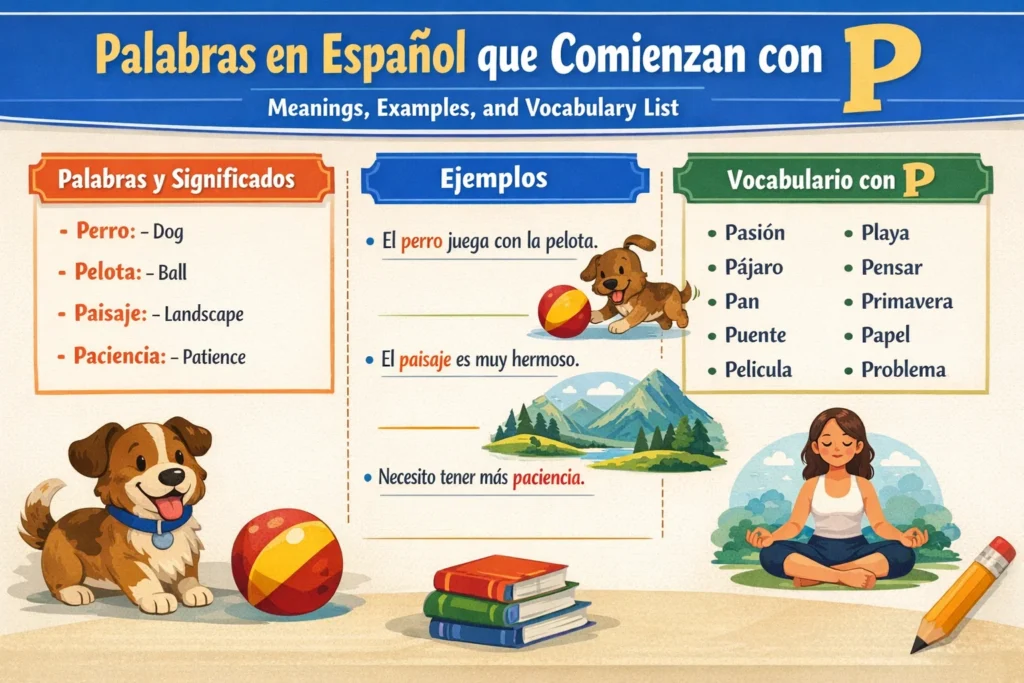

Spanish vocabulary is one of the most important steps toward fluency, and focusing on words that start with a specific letter can make learning easier and more organized. In this article, we explore Spanish words that start with the letter P, covering their meanings, usage, examples, and categories.
The letter “P” is very common in Spanish and appears in everyday conversation, academic language, business terms, emotions, places, and verbs. Whether you are a beginner, an intermediate learner, or an advanced student, this guide will help expand your Spanish vocabulary in a structured and practical way.
Why Learn Spanish Words That Start With P?
Learning vocabulary alphabetically offers several benefits:
Improves word recall and memory
Helps with dictionary usage
Strengthens spelling and pronunciation
Useful for language games, writing, and exams
Builds confidence in structured learning
Spanish words starting with P include some of the most frequently used words in the language, making them essential for daily communication.
Pronunciation of the Letter P in Spanish
In Spanish, the letter P is pronounced softly, unlike the aspirated “P” sound in English.
Spanish P = soft, unaspirated
Example: pan (bread), papel (paper)
Correct pronunciation helps you sound more natural when speaking Spanish.
Common Spanish Nouns That Start With P
Nouns are one of the most important parts of speech. Below are commonly used Spanish nouns starting with P.
Everyday Nouns
Pan – Bread
Padre – Father
País – Country
Palabra – Word
Persona – Person
Papel – Paper
Playa – Beach
Puerta – Door
Pueblo – Town / Village
Problema – Problem
Example Sentences:
El pan está fresco. (The bread is fresh.)
Ella es una buena persona. (She is a good person.)
Spanish Verbs That Start With P
Verbs are essential for forming sentences. Below are frequently used Spanish verbs beginning with P.
Common Verbs
Pagar – To pay
Pensar – To think
Poder – To be able to
Pasar – To pass / to spend time
Pedir – To ask for
Poner – To put / place
Parar – To stop
Parecer – To seem
Practicar – To practice
Preferir – To prefer
Example Sentences:
Quiero pagar la cuenta. (I want to pay the bill.)
Ella puede ayudarme. (She can help me.)
Spanish Adjectives That Start With P
Adjectives help describe people, objects, and emotions.
Common Adjectives
Pequeño/a – Small
Peligroso/a – Dangerous
Popular – Popular
Perfecto/a – Perfect
Posible – Possible
Pobre – Poor
Práctico/a – Practical
Paciente – Patient
Principal – Main
Positivo/a – Positive
Example Sentences:
Es un lugar peligroso. (It’s a dangerous place.)
Tiene una actitud positiva. (He/She has a positive attitude.)
Spanish Adverbs That Start With P
Adverbs modify verbs, adjectives, or other adverbs.
Poco – Little
Pronto – Soon
Perfectamente – Perfectly
Principalmente – Mainly
Probablemente – Probably
Example:
Probablemente llegaré tarde. (I will probably arrive late.)
Spanish Words Related to Food That Start With P
Food vocabulary is essential for daily conversations.
Pan – Bread
Pasta – Pasta
Pollo – Chicken
Pescado – Fish
Papa – Potato
Piña – Pineapple
Plátano – Banana
Pizza – Pizza
Postre – Dessert
Pimienta – Pepper
Spanish Words Related to Emotions and Feelings (P)
Paz – Peace
Placer – Pleasure
Pasión – Passion
Preocupación – Worry
Pena – Sadness / Shame
Paciencia – Patience
Orgullo – Pride (related but common in P-themes learning)
Example:
Busco paz y tranquilidad. (I seek peace and calm.)
Spanish Words Related to Travel and Places (P)
País – Country
Playa – Beach
Puerto – Port
Parque – Park
Plaza – Square
Provincia – Province
Pensión – Guesthouse
Pasaporte – Passport
Travelers will frequently encounter these words.
Spanish Academic and Professional Words Starting With P
Proyecto – Project
Programa – Program
Profesor/a – Teacher
Práctica – Practice
Producción – Production
Política – Politics / Policy
Presupuesto – Budget
Presentación – Presentation
These words are commonly used in education and workplaces.
Spanish Words Starting With “Pa-”
Papel – Paper
Pagar – To pay
Palabra – Word
Pasear – To walk
Paciente – Patient
Pareja – Couple
Spanish Words Starting With “Pe-”
Pequeño – Small
Peligro – Danger
Pensar – To think
Persona – Person
Perder – To lose
Spanish Words Starting With “Pi-”
Pintar – To paint
Piso – Apartment / Floor
Pienso – I think / animal feed
Piedra – Stone
Spanish Words Starting With “Po-”
Poder – To be able
Pobre – Poor
Policía – Police
Política – Politics
Población – Population
Spanish Words Starting With “Pr-”
Pregunta – Question
Problema – Problem
Práctica – Practice
Profesor – Teacher
Promesa – Promise
False Friends: Spanish P Words vs English
Some Spanish words starting with P look similar to English but have different meanings:
Pretender – To intend (not pretend)
Parientes – Relatives (not parents)
Plata – Silver (not plate)
Understanding these avoids confusion.
Tips for Learning Spanish Words Starting With P
Learn words in context
Practice pronunciation daily
Create example sentences
Use flashcards
Group words by category
Practice speaking aloud
How Many Spanish Words Start With P?
Thousands of Spanish words begin with the letter P, making it one of the most productive letters in the language. Mastering even a few hundred will significantly improve fluency.
Importance of the Letter P in Spanish Grammar
Appears in high-frequency verbs (poder, pensar, poner)
Common in nouns and adjectives
Important for professional and academic Spanish
Common Mistakes with Spanish P Words
Over-aspirating the P sound
Confusing false cognates
Incorrect gender agreement (pequeño / pequeña)
Final Thoughts
Spanish words that start with P play a vital role in everyday communication, academic writing, and professional conversations. From simple words like pan and persona to powerful verbs like poder and pensar, mastering these terms can dramatically improve your Spanish fluency.
By learning vocabulary systematically and practicing regularly,