
NASCAR is a sport built on speed, strategy, and strict regulations. Every track on the NASCAR calendar has its own unique challenges, but Sonoma Raceway stands out as one of the most demanding circuits in the series. Located in Northern California, Sonoma Raceway is a road course, unlike the traditional oval tracks that dominate NASCAR. Because of its tight turns, elevation changes, and heavy braking zones, Sonoma often becomes a hotspot for NASCAR penalties.
Over the years, Sonoma Raceway has witnessed numerous penalties ranging from pit road violations to safety-related infractions and post-race inspection failures. These penalties not only affect race outcomes but can also influence championship standings, team morale, and public perception of fairness in the sport.
This article provides a detailed 3,000-word guide to Sonoma Raceway NASCAR penalties, covering rules, common violations, notable incidents, and how penalties impact drivers, teams, and NASCAR as a whole.
Overview of Sonoma Raceway
Sonoma Raceway, formerly known as Sears Point Raceway, is a 2.52-mile road course featuring 12 turns and significant elevation changes. NASCAR’s top series, the Cup Series, along with the Xfinity Series, regularly compete at Sonoma.
Why Sonoma Is Different
Road course instead of oval
Heavy braking zones
Sharp left and right turns
Higher risk of wheel lockups and contact
Complex pit strategy
Because of these factors, Sonoma races often involve more on-track incidents, increasing the likelihood of NASCAR penalties.
Understanding NASCAR Penalties
NASCAR penalties are enforced to:
Ensure driver and crew safety
Maintain competitive fairness
Enforce technical and sporting regulations
Penalties can occur before the race, during the race, or after the race during inspections.
At Sonoma Raceway, penalties are especially common due to:
Tight pit road space
Aggressive driving on a road course
Frequent caution periods
High-pressure braking and tire management
Types of NASCAR Penalties at Sonoma Raceway
- On-Track Penalties
On-track penalties are among the most visible during a Sonoma race.
Common On-Track Violations
Cutting the course (shortcutting turns)
Causing avoidable contact
Blocking below the yellow line
Speeding under caution
Ignoring NASCAR official instructions
At Sonoma, drivers sometimes cut corners to gain time. NASCAR closely monitors these actions, and violations often result in pass-through penalties or time penalties.
- Pit Road Penalties
Pit road at Sonoma Raceway is narrow and challenging, increasing the likelihood of mistakes.
Common Pit Road Penalties
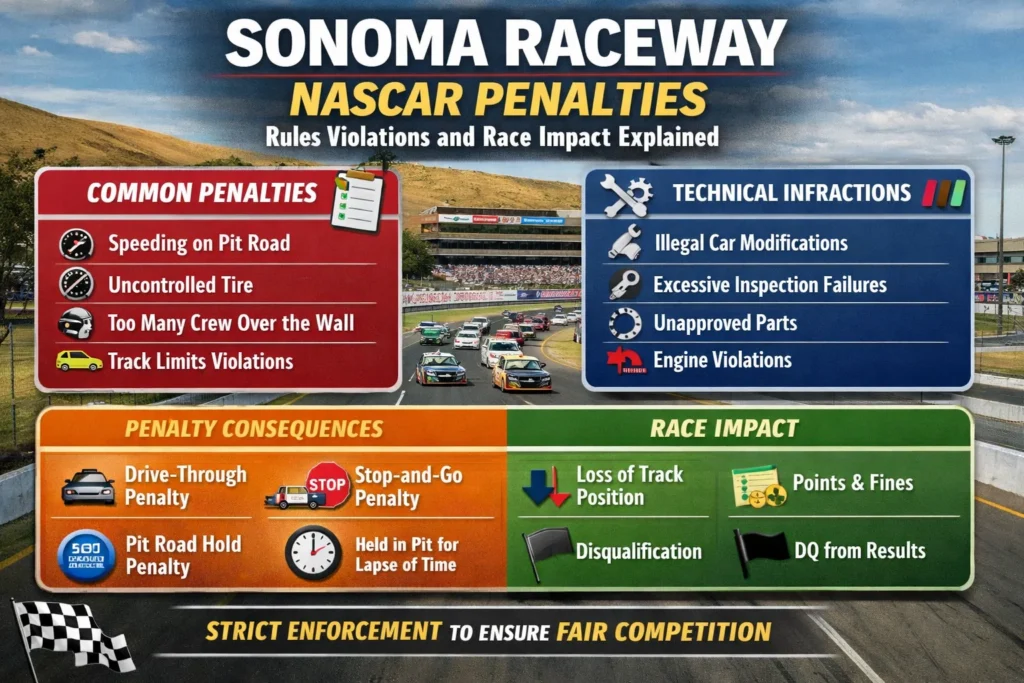
Speeding on pit road
Improper pit entry or exit
Too many crew members over the wall
Equipment crossing pit boundaries
Unsafe pit releases
Pit road penalties can cost a driver track position, which is extremely difficult to recover on a road course like Sonoma.
- Safety-Related Penalties
Safety is NASCAR’s top priority, and Sonoma races often lead to safety violations.
Examples of Safety Penalties
Loose wheels during or after pit stops
Improperly installed lug nuts
Unsafe car conditions
Debris falling from the car
A loose wheel penalty is one of the most severe safety violations. It can result in:
Suspension of pit crew members
Heavy fines
Loss of points
At Sonoma, the constant braking and turning place extreme stress on wheels and tires, making these penalties more common.
- Technical and Inspection Penalties
After every race, NASCAR conducts post-race inspections. Cars that fail inspection can face severe consequences.
Inspection Violations Include
Illegal car modifications
Engine or aerodynamic violations
Weight or height discrepancies
Unauthorized adjustments
If a car fails inspection at Sonoma:
The team may lose points
Fines may be issued
The crew chief may be suspended
Wins can be disqualified (in extreme cases)
Notable Sonoma Raceway NASCAR Penalty Incidents
Over the years, Sonoma Raceway has seen several high-profile penalty cases.
Loose Wheel Incidents
Multiple teams have been penalized at Sonoma for loose wheels during races. These penalties often lead to crew suspensions, sometimes lasting multiple races.
Post-Race Inspection Failures
Several drivers have lost valuable championship points due to cars failing post-race inspections at Sonoma. Even minor technical violations can carry serious consequences.
On-Track Shortcut Penalties
Road courses like Sonoma are closely monitored for track limits. Drivers who gain an advantage by cutting corners are typically penalized immediately.
How NASCAR Enforces Penalties at Sonoma
NASCAR uses advanced systems to ensure fairness:
Electronic timing and scoring
Pit road speed sensors
Video replay from multiple angles
Spotters and race officials stationed around the track
At Sonoma, NASCAR officials pay extra attention to:
Track limit violations
Pit road entry and exit
Safety-related issues
Penalty Severity Levels
Not all penalties carry the same weight. NASCAR categorizes penalties based on severity.
Minor Penalties
Restart at the back of the field
Pass-through penalty
Time penalty
Major Penalties
Points deductions
Heavy fines
Crew suspensions
Disqualification
At Sonoma Raceway, even minor penalties can be devastating due to limited passing opportunities.
Impact of Penalties on Race Outcomes
Penalties at Sonoma can dramatically change race results.
Track Position Matters
Because Sonoma is a road course:
Passing is difficult
Strategy plays a huge role
Track position is critical
A single pit road penalty can turn a potential top-5 finish into a mid-pack result.
Championship Implications
Penalties at Sonoma don’t just affect one race—they can influence an entire season.
Loss of playoff points
Reduced standings position
Increased pressure on teams
For drivers fighting for playoff spots, a penalty at Sonoma can be a season-defining moment.
Team Strategy and Risk Management
Teams prepare extensively to avoid penalties at Sonoma.
Key Preparation Areas
Pit crew practice
Brake and tire management
Driver discipline on track limits
Strict compliance with NASCAR rules
Many teams adopt a conservative approach at Sonoma to avoid costly mistakes.
Fan Reactions to Sonoma Penalties
NASCAR penalties often spark debate among fans.
Common Fan Opinions
Some believe penalties maintain fairness
Others feel rules are enforced inconsistently
Road course penalties are often controversial
Social media frequently lights up after Sonoma races, especially when penalties affect popular drivers.
NASCAR’s Perspective on Penalties
From NASCAR’s standpoint, penalties are essential to:
Protect drivers and crews
Maintain competitive integrity
Ensure consistent rule enforcement
NASCAR has stated that safety violations, especially loose wheels, will always be treated seriously.
Comparison With Other Road Courses
Sonoma penalties are often compared with:
Watkins Glen
Circuit of the Americas (COTA)
Chicago Street Course
While penalties occur at all road courses, Sonoma’s tight layout and elevation changes make it one of the most challenging.
How Drivers Can Avoid Penalties at Sonoma
Drivers focus on:
Staying within track limits
Respecting pit road speed
Avoiding aggressive shortcuts
Communicating clearly with their crew
Experience plays a major role; veteran drivers tend to perform better with fewer penalties.
The Future of Penalties at Sonoma Raceway
As NASCAR evolves:
Technology will improve penalty detection
Rules may be refined for road courses
Consistency in enforcement will remain a priority
With more road courses added to the schedule, Sonoma continues to serve as a benchmark for NASCAR rule enforcement.
Conclusion
Sonoma Raceway NASCAR penalties are an integral part of racing at one of the sport’s most complex venues. From pit road violations and on-track infractions to safety and inspection penalties, Sonoma consistently tests teams, drivers, and officials alike.
Penalties at Sonoma don’t just shape individual races—they influence championships, strategies, and the ongoing debate about fairness in NASCAR. As the sport grows and evolves, Sonoma Raceway will remain a critical stage where rules, discipline, and performance collide.