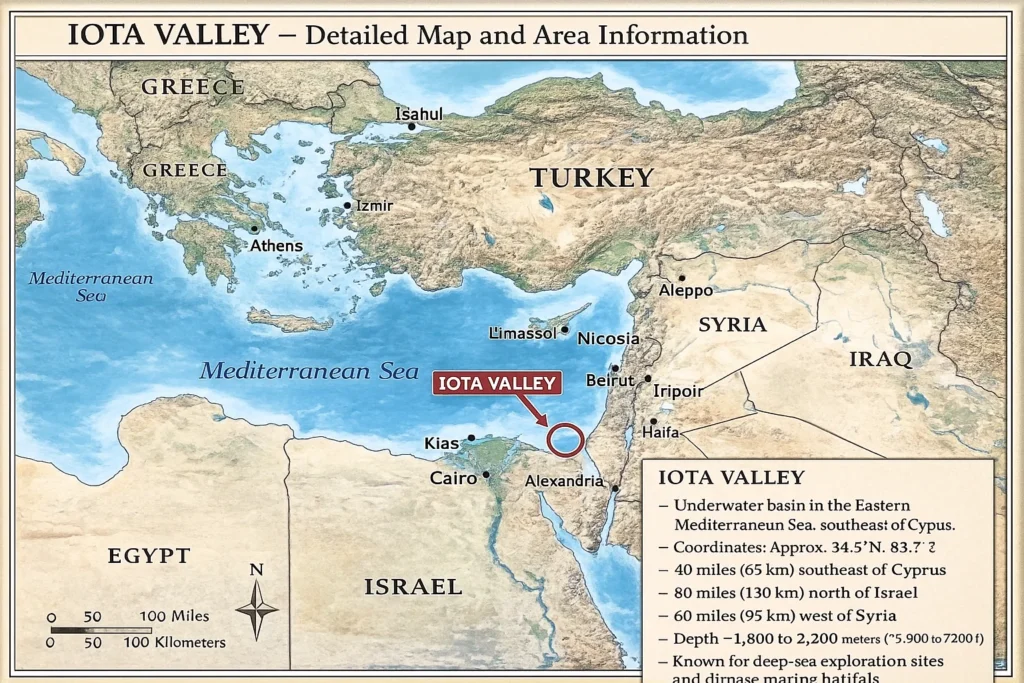

In the vast realm of maps—from the precise grids of ordnance surveys to the fantastical coastlines of fictional worlds—there exists a peculiar and captivating category: the map of a place that cannot be definitively located, a territory defined more by idea than by geography. Among these, the purported “Iota Valley” stands as a quintessential enigma. A search for its coordinates yields no consensus, for Iota Valley is less a physical destination and more a conceptual landscape, a cipher whose meaning shifts with the context of its seeker. This article is not a guide to a tangible location but a cartography of a mystery, tracing the contours of Iota Valley across technology, linguistics, fiction, and the human psyche. We will explore its possible origins, its myriad interpretations, and why the very idea of mapping it is a profound exercise in understanding how we impose order on ambiguity.
Part I: The Technological Seed – IOTA and the Tangle
The most concrete and likely genesis of the term in the modern lexicon springs from the world of cryptocurrency and distributed ledger technology. IOTA is a pioneering open-source distributed ledger designed for the Internet of Things (IoT). Its foundational structure is not a traditional blockchain but a directed acyclic graph (DAG) it calls “The Tangle.”
The Metaphor of the Valley: Within this technical framework, “Iota Valley” could emerge as a conceptual metaphor. If one visualizes the data landscape of IOTA—a vast, interconnected, and constantly growing network of transactions and devices—it might resemble a sprawling, digital topography. The “valley” could represent:
A Developmental Phase: A specific, perhaps foundational, period in IOTA’s ecosystem development.
A Community Hub: The collective space of its developers and early adopters, a niche within the broader crypto “mountains.”
A State of the Network: A metaphorical low point (a trough) or a fertile ground (a river valley) for innovation.
Thus, the most literal “map” of Iota Valley might be a network visualization diagram of The Tangle—a chaotic yet elegant web of nodes and connections, representing a valley not of earth and rock, but of data and trustless agreements.
Part II: The Linguistic and Philosophical Terrain
Stepping back from technology, “iota” itself is a word laden with meaning. Derived from the Greek letter Ι, ι, it is the smallest letter in the Greek alphabet. In English, it has come to mean an infinitesimally small amount (“not one iota of truth”).
The Valley of the Minuscule: From this perspective, “Iota Valley” transforms into a philosophical or literary construct. It could be:
The Realm of Details: A metaphorical place where minutiae are magnified, where the smallest components of a system are studied and celebrated. To “map” Iota Valley would be to create a detailed taxonomy of the seemingly insignificant.
A Zen-like Concept: The valley where one goes to comprehend the universe in a grain of sand, to find the profound within the trivial. Its map would be less geographical and more a set of meditative instructions.
A Satirical or Bureaucratic Hellscape: Imagine a Kafkaesque bureaucracy obsessed with trivialities. Iota Valley could be its headquarters—a mapped maze of offices dedicated to processing infinitely small details.
Here, the cartography is abstract. The “map” might be a philosophical treatise, a poem, or a complex flowchart detailing the branches of a single, tiny decision.
Part III: The Fictional and Folkloric Fabric
Many of history’s most compelling places exist only in narrative. Iota Valley fits neatly into this tradition as a potent blank canvas for storytelling.
Genre Possibilities:
Science Fiction: A hidden valley on a distant moon, rich with Iota particles, a rare element that powers faster-than-light travel but warps reality. The map is a star chart leading to a treacherous planetary feature.
Fantasy: The Valley of the Iota, a secluded land where a forgotten order of scribes guards the Prime Letter, the source of all linguistic magic. Its map is an illuminated manuscript, with clues hidden in the strokes of ancient letters.
Literary Fiction: “Iota Valley” could be the ironic nickname for a bland, uneventful suburban development, its map a sterile plat from the county recorder’s office, masking the profound human dramas within each identical house.
Horror: A place where things lost or forgotten—the iotas of memory, the smallest regrets—accumulate and take on a sinister life of their own. The map is a fading memory, redrawn with each forgotten sin.
In this realm, the map is a narrative device. It might be presented as a treasure map within the story, a clue for the protagonist (and the reader) to decipher. The act of mapping Iota Valley becomes the plot itself.
Part IV: The Psychological and Memetic Landscape
In the age of the internet, ideas morph and propagate as memes. “Iota Valley” could exist as a meme or an inside joke within online communities.
The Unfindable Paradise: It could be a tongue-in-cheek reference to an idealized, unspoiled place that doesn’t exist—a more obscure version of “the backwoods of nowhere.” Its map is a deliberately confusing or absurdist image shared on forums.
A Personal Cognitive Map: For an individual, Iota Valley might represent a state of mind—a place of quiet focus, of delving into a niche hobby or a specialized field of knowledge. To map it is to journal or create a mind map of one’s passions.
The Collective Unconscious: Drawing from Jung, it could symbolize a universal archetype of a hidden, fertile, and deeply personal inner space. The collective “map” is the body of world myth and art that depicts such introspective journeys.
Part V: Attempting a Composite Cartography – What Would a “Map” Encompass?
Given these multifaceted interpretations, what would a true, composite “Map of Iota Valley” attempt to depict? It would necessarily be a multilayered, palimpsestic work.
The Base Layer (The Technological Grid): A faint, underlying visualization of a network graph, representing The Tangle or any complex system of interconnected points.
The Topographical Layer (The Fiction): Overlaid, one might find the features of a classic valley—a river (perhaps named “Stream of Consciousness”), mountains named “Peak of Certainty” and “Cliff of Doubt,” and a forest called “The Details.”
The Linguistic Layer: Annotations in multiple languages and scripts, focusing on tiny details, footnotes, and etymologies, highlighting the valley’s connection to the minuscule.
The Psychogeographic Layer: Markings indicating zones of emotional or cognitive experience: “The Bog of Procrastination,” “The Meadow of Insight,” “The Labyrinth of Trivia.”
The Legend/Key: This would be the most important part, explaining that the map is not a guide to a physical place, but a tool for navigation through conceptual spaces. Its scale is measured in ideas, not miles. Its compass points not to north, but to curiosity, analysis, abstraction, and narrative.
Conclusion: The Valley That Is a Mirror
The enduring intrigue of “Iota Valley” lies in its perfect ambiguity. It is a projective test in geographical form. What one seeks in its map reveals one’s own preoccupations: the technologist sees a network, the writer sees a setting, the philosopher sees a paradox, the linguist sees a unit of measure.
To demand a single, authoritative map of Iota Valley is to misunderstand its fundamental nature. It is not a place waiting to be discovered, but a concept waiting to be defined. Its terrain is shaped by the questions we ask of it. Are we looking for data, for story, for meaning, or for escape?
Therefore, the ultimate map of Iota Valley is not a document one consults, but one that one creates. It is the ongoing project of connecting the tiny (the iota) to the vast (the valley), of finding fertile ground in the smallest details, and of charting a course through the ever-expanding landscape of human knowledge and imagination. In the end, we do not find Iota Valley on any atlas; we realize we have been walking its paths all along, in every minute observation, every niche interest, and every story we choose to tell. The valley is not out there; it is the map we are constantly, inevitably, drawing within.