

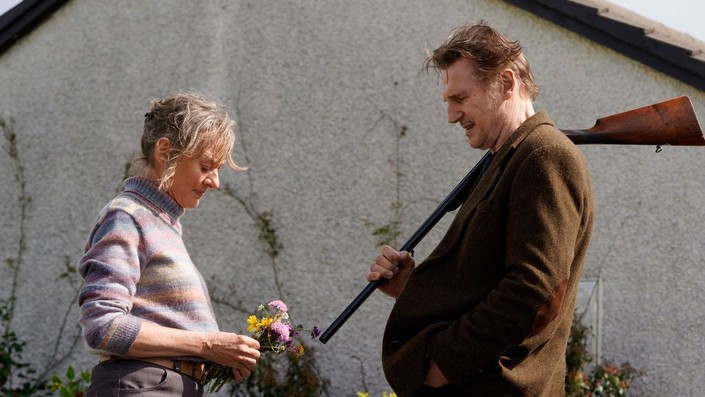
“In the Land of Saints and Sinners” burst onto screens in 2024 as a gritty Irish-set action thriller, starring Liam Neeson as a reformed killer trying to escape his violent past. The film appeals to those who enjoy Western-style redemption stories, neo-westerns transplanted to the Irish countryside, and morally complex narratives about crime, guilt, and vengeance.
One striking feature: the film has earned a strong reception on Rotten Tomatoes, prompting many to wonder: is this one of Neeson’s best recent outings? In this article, we explore:
What the Rotten Tomatoes score really means
What the film is about (plot, setting, characters)
Critical praise: what works
Common criticisms: what doesn’t work as well
Themes and deeper readings
Who might enjoy this film — and who might not
Final verdict
Rotten Tomatoes & Critical Reception
🍅 Rotten Tomatoes Score
According to Rotten Tomatoes, In the Land of Saints and Sinners holds an 83% “Tomatometer” based on critic reviews and a 74% “Popcornmeter/Audience Score” from general viewers.
Rotten Tomatoes
The 83% Tomatometer places the film solidly in “fresh” territory.
The “Critics Consensus” on Rotten Tomatoes describes the film as:
“Well-written and classically constructed, In the Land of Saints and Sinners is one of the better action thrillers Liam Neeson’s made in recent years.”
Rotten Tomatoes
This suggests that among Neeson’s late-career movies, this one stands out for quality, at least in the eyes of many critics.
Metacritic & Mixed Signals
However, the reception isn’t universally glowing. On Metacritic the film has a “Mixed or Average” score: a Metascore of 60 based on 14 critic reviews
According to Metacritic’s breakdown: 57% of the 14 reviews are “positive,” 43% “mixed,” with none “negative.”
This divergence between Rotten Tomatoes and Metacritic reflects a common phenomenon: many critics liked the film enough to mark it “fresh,” but a sizable fraction felt it had noticeable issues or simply remained average compared to standout cinema.
Notable Critical Praise
Many critics singled out highlights:
Performances: Especially Neeson’s brooding gravitas and Kerry Condon’s chilling intensity as antagonist were frequently praised.
Atmosphere & Setting: The Irish coastal village, 1970s period detail, rugged landscapes — the film’s setting contributes heavily to its tone.
A Return to Gritty, Character-Driven Thriller: Some noted this film feels more mature and grounded than many of Neeson’s recent action flicks.
For instance, in the review on a big film site:
“Neeson is as sturdy as ever … and Condon excels, giving a stock character a shudder of intensity.”
Roger Ebert
Another review highlights it as “one of Neeson’s best movies of the past few years.”
Common Criticisms & Mixed or Negative Reviews
But even with praise, critics also raised concerns — often around story, pacing, or under-utilized characters:
Predictability / Formulaic Plot: Several reviews mention the plot meanders, or feels derivative, especially for a revenge thriller / western
Underdeveloped Supporting Characters: While leads do well, many secondary characters reportedly feel thin, underused, or stereotypical.
Tonal inconsistency: A few critics felt the film “can’t decide on a tone,” oscillating between contemplative western-style drama and pulpy revenge thriller.
Cultural/historical depth lacking: For a film set in a fraught period of Irish history (the 1970s, amid political violence), some reviewers felt the film does not deeply engage with the historical/political context — focusing more on personal vengeance than larger social issues
In the words of one reviewer: though there are “bits and pieces of entertaining stuff here … the overall tone of cliché is a bit wearing.”
What the Film Is About — Synopsis & Setting
To understand why In the Land of Saints and Sinners divides opinion, it helps to know its story and how it uses its setting.
Setting: 1974, Ireland — a time of political unrest, but the film centers on a remote coastal village in Donegal, away from much of the open conflict.
Protagonist: Finbar Murphy (played by Liam Neeson), a former assassin trying to abandon violence and lead a quiet life.
Conflict: A group of terrorists — led by a ruthless woman, Doireann McCann (played by Kerry Condon) — arrive in Finbar’s village to hide after a botched bombing, which had resulted in civilian casualties.
Moral Choice & Violence: As the terrorists’ threat grows, Finbar is drawn into conflict. He must decide whether to stay silent, preserving his attempt at redemption, or defend the innocent and face brutal consequences — risking exposure of his identity and past.
The film mixes the tension of a crime thriller, the moral ambiguity of a western anti-hero tale, and the atmospheric melancholy of a 1970s rural Irish drama.
What Works: Strengths of Saints and Sinners
- Performances — Especially from Neeson & Condon
Perhaps the film’s greatest asset is its cast and especially the performances:
Liam Neeson delivers a brooding, world-worn performance as Finbar. His portrayal carries the film’s emotional weight, grounding the character’s internal conflict and weariness.
Roger Ebert
+2
Metacritic
+2
Kerry Condon, as Doireann McCann, brings intensity and menace; many critics singled out her performance as a standout that elevates what might otherwise be a fairly standard villain role.
Metacritic
+2
Rotten Tomatoes
+2
The supporting cast — including actors like Colm Meaney and Ciarán Hinds — adds authenticity and depth to the village setting, giving the film a communal, lived-in feeling.
Wikipedia
+1
- Atmosphere & Setting: Ireland as a Character
The film leverages its Irish coastal setting to full effect. The windswept cliffs, rural cottages, dry-stone walls, and 1970s period details give it a distinctive look and feel — evoking a kind of neo-western vibe.
Wikipedia
+2
Roger Ebert
+2
This aesthetic helps the film transcend being just “another throwaway action flick.” The mood, the environment, the cultural flavor — they all contribute to a more immersive cinematic experience.
- A Gritty, Mature Take on Revenge — Not Glossy or Polished
Unlike many modern action movies that over-rely on spectacle and high-octane sequences, Saints and Sinners often opts for a grittier, more grounded tone. The film doesn’t shy away from the ugliness of its themes — violence, guilt, moral ambiguity — and it gives its characters weight.
Roger Ebert
+2
Metacritic
+2
The story doesn’t sugarcoat its conflict; it shows the cost of vengeance, the heavy burden of conscience, and the toll that past sins can take when they catch up. For viewers looking for a darker, more contemplative thriller with action grounded in realism — this film delivers.
What Falls Short: Weaknesses & Criticisms
Of course, no film is perfect — especially one navigating such morally complex terrain. Here are frequent critiques:
- Predictability & Familiar Plot Tropes
Critics often highlight that the overall story arc feels familiar: a reformed killer drawn back into violence, a group of terrorists hiding in a small town, eventual moral reckoning. For some viewers, that familiarity undercuts suspense or the emotional impact.
Roger Ebert
+2
IMDb
+2
In fact, one review summed it up: though parts are entertaining, “the overall tone of cliché is a bit wearing.”
Rotten Tomatoes
+1
When the mid-section of the film slows or lingers too much, the lack of surprises becomes more apparent.
Roger Ebert
+1
- Under-developed Secondary Characters
While the leads shine, many supporting roles reportedly lack depth. Some characters seem superfluous, or aren’t given enough screen time to form meaningful arcs.
Rotten Tomatoes
+2
Wikipedia
+2
This unevenness can make parts of the narrative feel hollow — as if the film relies too heavily on its leads to carry weight.
- Weak Pacing / Tonal Inconsistencies
A recurring critique: the film sometimes meanders. It struggles with balancing intimate drama, moral tension, and violent thrills. At times it feels like a slow-burn character piece; at others, like a standard vengeance thriller. This shifting tone may disorient viewers.
Roger Ebert
+2
IMDb
+2
For those expecting consistent pacing or a fast-moving revenge flick, these slow patches may feel like drag.
- Limited Historical/Political Depth
Given its 1970s Irish setting — a time fraught with political conflict — some viewers expected the film to engage more deeply with historical or political themes. Instead, it focuses primarily on personal vengeance and morality, largely sidestepping broader social or historical commentary.
Wikipedia
+2
Roger Ebert
+2
That may disappoint those hoping for a more layered examination of the period; for others, the film’s choice to zero in on individual moral conflict may be a feature rather than a bug.
Themes & Deeper Interpretations
Even with its flaws, In the Land of Saints and Sinners offers several themes and layers for reflection — which may be why many critics respond more positively than negatively.
Redemption & Guilt
At its core, the film explores whether a violent past can ever be truly left behind. Finbar Murphy tries to reinvent himself, yet his past — and the consequences of others’ violence — force him into reckoning. The film asks: Can a man burdened by sin ever find redemption?
His journey is not heroic in a traditional sense; it’s heavy, weary, and morally ambiguous. That realism — that refusal to simplify vengeance or redemption — gives the film emotional weight.
Violence — Justified or Not?
The film doesn’t shy away from showing violence’s cost. But it also raises uncomfortable questions: when does vengeance become justice? When does protecting the innocent justify bloodshed? For some viewers, the moral ambiguity drives the drama; for others, it might feel like glorification.
The clash between a former assassin seeking peace and terrorists bringing chaos to a small village underscores the tension between personal moral codes and the brutal reality of political violence.
Isolation, Identity & the Shadows of the Past
Set in a remote Irish village, the film uses isolation — both geographical and psychological — to reflect Finbar’s internal state. The landscapes, the sea, the fog, the empty roads: they echo emptiness, solitude, and the weight of a life once lived in blood.
The film suggests that one cannot outrun identity or past choices — they linger, often where you least expect them.
Moral Ambiguity & Redemption as a Process, Not a Destination
Unlike many action-revenge films, Saints and Sinners doesn’t promise neat closure. The ending is violent, morally ambiguous, and leaves lingering questions. Redemption isn’t a trophy — it’s a painful process, often incomplete.
For viewers open to complexity and moral uncertainty — rather than neat resolutions — this approach lends the film depth.
Who Should Watch It — And Who Might Not Love It
✅ People Who Might Appreciate the Film
Fans of Liam Neeson — especially those who enjoy his more serious, gritty roles rather than corpo-action flicks.
Viewers who like character-driven thrillers over flashy action — movies that explore guilt, redemption, and moral complexity.
People who enjoy neo-westerns or revenge dramas set in rugged environments — especially with a moody, atmospheric tone.
Those interested in a psychological take on violence and morality, rather than pure action.
Viewers drawn to Irish settings, culture, and landscape — the film leverages its setting effectively.
⚠ People Who Might Not Enjoy It
Viewers expecting light entertainment or glossy action — the film is often heavy, sometimes slow, and not shy of moral ambiguity.
Those wanting historical or political depth about 1970s Ireland. The film touches lightly on “the Troubles” backdrop, but doesn’t deeply engage with broader socio-political themes.
People who dislike slow pacing or tonal shifting, or prefer tightly plotted thrillers with constant action and minimal introspection.
Viewers sensitive to violence, moral ambiguity, or darker themes — the film doesn’t sugarcoat its brutality, and its moral stance is often gray, not black-and-white.
Comparing to Other Late-Period Liam Neeson Films
In recent years, Neeson has starred in many thrillers and action-oriented films. Some lean toward formulaic, high-octane violence or straightforward revenge. What makes In the Land of Saints and Sinners different — and often more praised — is its grounded, introspective tone, willingness to embrace moral complexity, and use of setting and atmosphere for deeper emotional texture.
Critics often note this film as one of Neeson’s “better recent” works, especially compared to his “geriaction” — action-hero-in-old-age — roles.
Metacritic
+2
Metacritic
+2
It may not reinvent the wheel, but for those who appreciate a carefully crafted, mature thriller, it stands out.
Final Verdict: Is In the Land of Saints and Sinners Worth Watching?
Yes — with caveats.
If you approach the film expecting deep political commentary, fast-paced action, or neat moral resolution, you might come away disappointed. But if you’re open to a slower, moodier, more introspective thriller — one that explores guilt, redemption, and the burden of a violent past — then In the Land of Saints and Sinners is a worthy watch.
It’s not perfect: the plot can feel familiar, some characters underwritten, and pacing uneven. But strong central performances, evocative setting, and willingness to grapple with dark, messy human truths give it more depth than many standard revenge thrillers.
Given its 83% Rotten Tomatoes rating and generally favorable critical response, it’s arguably one of the more successful films of Neeson’s later career — and a solid pick for viewers who like morally ambiguous thrillers with soul.
Reflections & Personal Thoughts
When the credits rolled on In the Land of Saints and Sinners, what stayed with me wasn’t the gunfights or explosions — but the lingering quiet after violence, the weathered faces of people haunted by past deeds, and the uneasy question: can we ever truly escape who we once were?
In a cinematic landscape saturated with action flicks and disposable thrills, this movie offers something different: a bruised, melancholic, morally murky story. It doesn’t promise redemption. It offers a chance for reflection. And sometimes, that’s exactly what a film should do.
If you decide to watch it: brace for rough edges, but stay for the atmosphere, the performances, and the echoes of regret that linger long after the credits.